This site uses third-party website tracking technologies to provide and continually improve our services, and to display advertisements according to users' interests. I agree and may revoke or change my consent at any time with effect for the future.
Managed Service Providers (MSPs) are caught in a paradox. Your clients expect faster response times, proactive support, and seamless service delivery, yet your teams are drowning in repetitive tasks, alert fatigue, and manual workflows that haven't evolved in years. The traditional MSP model, built on reactive troubleshooting and hands-on intervention, simply doesn't scale in today's environment where IT complexity grows exponentially.
AI automation isn't just another buzzword to add to your marketing deck. It's fundamentally reshaping how high-performing MSPs deliver value, freeing technical talent from mundane work and redirecting them toward strategic initiatives that actually move the needle. In this article, we'll explore how AI automation drives measurable efficiency gains for MSPs, which solutions deliver the most impact, and how to implement automation without disrupting your existing operations.
Understanding AI Automation Technologies for MSPs
AI automation for MSPs goes beyond simple scripting or rule-based workflows. Modern AI systems leverage machine learning algorithms that learn from historical data, natural language processing to understand context in tickets and alerts, and predictive analytics that anticipate issues before they impact clients. These technologies work together to handle tasks that previously required human judgment, triaging support tickets, identifying security anomalies, or predicting hardware failures.
The key difference between traditional automation and AI-driven automation is adaptability. Where a script follows predetermined logic, AI systems improve over time, recognizing patterns your team might miss and adjusting responses based on outcomes. For MSPs managing hundreds of endpoints across multiple client environments, this learning capability transforms operational efficiency.
Evolving Trends in AI-Driven Managed Services
The MSP landscape is shifting rapidly, with the global managed services market projected to reach $731 billion by 2030. We're seeing three major trends reshape how AI automation integrates into service delivery:
Autonomous remediation: AI systems that don't just detect issues but automatically resolve common problems without human intervention
Conversational AI interfaces: Chatbots and virtual assistants that handle tier-1 support queries, reducing ticket volume by 30-40%
Predictive service models: Moving from reactive "break-fix" to proactive maintenance based on AI-driven forecasting
These aren't futuristic concepts. Leading MSPs are already deploying these capabilities, creating competitive advantages that smaller providers struggle to match without similar automation investments.
Impact of AI on Traditional MSP Operations
AI automation fundamentally changes the MSP operating model. Traditional workflows built around technician availability and manual escalation paths are being replaced by intelligent systems that handle routine work 24/7. This shift impacts staffing models, you need fewer tier-1 technicians but more specialists who can manage AI systems and handle complex escalations.
The financial implications are significant. MSPs typically operate on thin margins, and labor represents the largest operational expense. AI automation doesn't eliminate jobs; it redirects human expertise toward higher-value activities that clients will actually pay premium rates for, strategic consulting, security architecture, and digital transformation initiatives.
Key Benefits of AI Automation for MSPs
Boosting Productivity and Efficiency
The productivity gains from AI automation are measurable and immediate. MSPs implementing intelligent automation report 40-60% reductions in time spent on routine tasks like password resets, software provisioning, and alert triage. Your technicians stop playing whack-a-mole with alerts and start focusing on work that requires genuine expertise.
Consider a typical scenario: A client reports slow application performance. Without automation, your team manually checks server logs, network metrics, and application health across multiple tools, a process that takes 30-45 minutes. With AI-powered monitoring, the system correlates data across sources, identifies the root cause, and often implements the fix before the client even notices a problem. That's not incremental improvement; it's a fundamental shift in service delivery.
Enhancing Service Quality and Reliability
AI automation improves service consistency in ways manual processes simply can't match. Human technicians have good days and bad days. They forget steps, miss alerts during busy periods, or apply inconsistent troubleshooting approaches. AI systems maintain the same level of performance regardless of workload, time of day, or complexity.
More importantly, AI-driven systems learn from every interaction. When your best technician develops a clever workaround for a recurring issue, that knowledge typically stays locked in their head. AI automation captures that expertise and applies it consistently across all similar incidents, effectively scaling your best practices across your entire service delivery team.
Lowering Operating Costs for MSPs
The cost benefits of AI automation compound over time. Initial savings come from reduced labor hours on routine tasks. But the real ROI emerges from improved client retention (fewer service issues mean lower churn), increased capacity to take on new clients without proportional staff increases, and the ability to offer premium services that justify higher contract values.
MSPs using AI automation report 25-35% reductions in operational costs within the first year, primarily through reduced overtime, fewer emergency escalations, and improved resource allocation. These aren't theoretical savings, they show up directly in your P&L statements.
AI Automation Solutions Commonly Used by MSPs
Intelligent Monitoring and Alert Systems
Traditional monitoring tools generate hundreds of alerts daily, most of which are false positives or low-priority issues. AI-powered monitoring systems apply machine learning to filter noise, correlate related alerts, and surface only the issues that genuinely require attention. This reduces alert fatigue and ensures your team focuses on real problems.
These systems establish baselines for normal behavior across your client environments, then flag anomalies that might indicate emerging issues. Instead of reacting to threshold violations, you're identifying trends that suggest future problems, a fundamental shift from reactive to proactive service delivery.
AI-Powered Help Desk Automation
Modern help desk platforms use natural language processing to understand ticket content, automatically categorize requests, route them to appropriate technicians, and even suggest solutions based on historical resolutions. Some systems can resolve common requests entirely without human intervention, password resets, access requests, and software installation tickets that previously consumed significant technician time.
The key is intelligent routing. AI systems learn which technicians excel at specific issue types and automatically assign tickets accordingly, improving first-contact resolution rates and reducing escalations.
Predictive Maintenance and Analytics
Predictive maintenance represents one of the highest-value applications of AI for MSPs. By analyzing historical performance data, usage patterns, and failure indicators, AI systems predict when hardware will fail, when software updates will cause compatibility issues, or when capacity constraints will impact performance.
This shifts your service model from reactive troubleshooting to proactive maintenance. You're scheduling replacements during planned maintenance windows instead of responding to emergency outages. Your clients experience fewer disruptions, and your team avoids the chaos of emergency response.
Automating Access Management
Identity and access management is a critical security function that's traditionally been time-consuming and error-prone. AI automation streamlines access provisioning, deprovisioning, and ongoing access reviews, ensuring employees have appropriate permissions without manual intervention for every request.
Platforms like Josys use AI to automate access reviews, identifying risky permissions, unused licenses, and compliance gaps across your clients' SaaS environments. This is particularly valuable for MSPs managing multiple client tenants, where manual access reviews would require dozens of hours per client each quarter.
Automating Routine MSP Tasks with AI Tools
Ticket Management and Resolution Automation
AI-driven ticket management goes beyond simple categorization. Modern systems analyze ticket content, compare it against your knowledge base and historical resolutions, and either automatically resolve the issue or provide technicians with detailed solution guidance. This dramatically reduces mean time to resolution (MTTR) and improves consistency across your support team.
The system learns from every ticket closure, continuously improving its ability to suggest relevant solutions. Over time, your knowledge base becomes a living resource that actively contributes to faster resolutions rather than sitting as static documentation your team rarely references.
Streamlining Onboarding and Offboarding
Employee onboarding and offboarding involve dozens of tasks across multiple systems, creating accounts, assigning licenses, configuring access permissions, and provisioning hardware. AI automation orchestrates these workflows, ensuring consistent execution while reducing the time required from hours to minutes.
For offboarding, automation is even more critical from a security perspective. AI systems ensure immediate access revocation across all systems when an employee departs, eliminating the risk of orphaned accounts or delayed deprovisioning that creates security vulnerabilities.
Automating Security Incident Response
Security incidents require rapid response, but most MSPs lack the staff to monitor security alerts 24/7. AI-powered security automation monitors for threats, correlates indicators of compromise across multiple data sources, and executes initial response actions, isolating affected systems, blocking malicious IPs, or triggering additional authentication requirements.
This doesn't replace your security team; it augments their capabilities by handling initial containment while your analysts focus on investigation and remediation. Organizations using security AI extensively have saved $1.9 million per breach on average, underscoring the impact of faster response times and reduced blast radius from security incidents.
Features to Consider in an AI Automation Platform for MSPs
Integration with PSA and RMM Systems
Your AI automation platform must integrate seamlessly with your existing Professional Services Automation (PSA) and Remote Monitoring and Management (RMM) tools. Standalone solutions that require manual data transfer or duplicate workflows create more problems than they solve.
Look for platforms offering native integrations or robust APIs that enable bidirectional data flow. The automation system should pull data from your RMM for decision-making and push updates back to your PSA for billing and documentation, creating a unified workflow rather than another tool to manage.
Customization and Scalability Options
Every MSP has unique workflows and client requirements. Your automation platform should offer customization options that let you tailor automated processes to your specific service delivery model without requiring extensive development resources.
Equally important is scalability. The platform should handle your current client base while accommodating growth without performance degradation or exponential cost increases. Cloud-native platforms typically scale more effectively than on-premises solutions.
Security and Compliance Management Features
AI automation platforms access sensitive client data and often have privileged access to critical systems. Security isn't optional, it's fundamental. Look for platforms offering encryption at rest and in transit, role-based access controls, comprehensive audit logging, and compliance certifications relevant to your client base (SOC 2, ISO 27001, GDPR compliance).
The platform should also help you maintain compliance rather than creating additional compliance burden. Automated documentation, access reviews, and security reporting should be built-in features, not afterthoughts.
Real-World Success Stories: MSPs Leveraging AI Automation
Advisory Leverages Josys To Automate Access Reviews
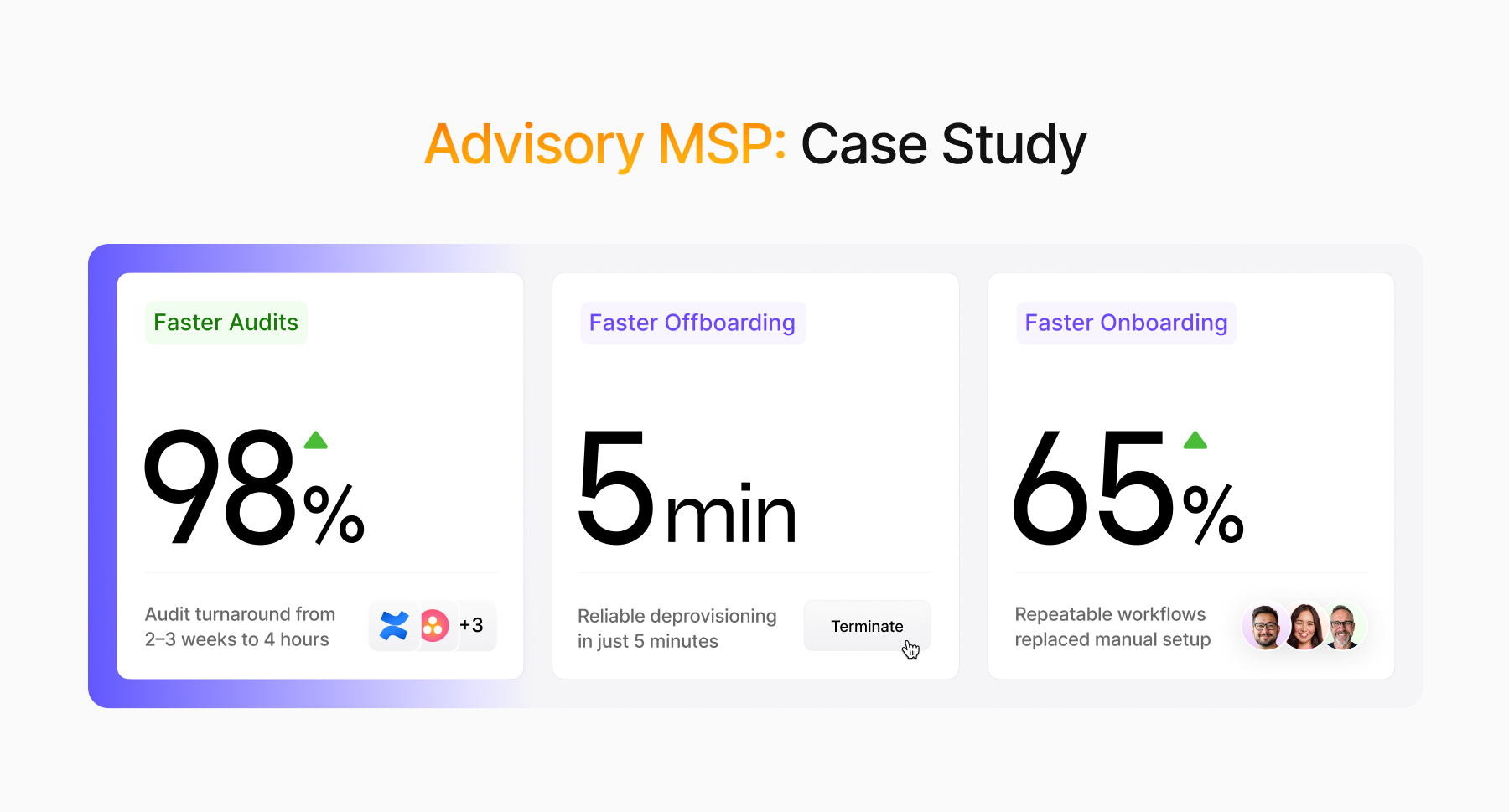
Advisory, a managed service provider, faced a common challenge: conducting access reviews for clients was consuming excessive staff time while providing limited visibility into actual security risks. Manual reviews across dozens of SaaS applications for each client took 2 to 3 weeks and the process often missed risky permissions or unused licenses.
By implementing Josys's AI-powered access management platform, Advisory automated the entire access review process. The system continuously monitors user permissions across all client SaaS applications, automatically identifies anomalies and risky access patterns, and generates comprehensive reports that previously required manual compilation.
The results were immediate: a maximum of 4 hours to return actionable audits to clients. More importantly, the automated system identified security risks that manual reviews had consistently missed, shared credentials, excessive admin permissions, and orphaned accounts from former employees. Advisory now offers access governance as a premium service differentiator, turning what was once a cost center into a revenue opportunity.
Challenges and Best Practices in Adopting AI Automation
Overcoming Staff Resistance to AI Integration
Technicians often view automation as a threat to their jobs rather than a tool to enhance their work. Address this directly through transparent communication about how automation will redirect their efforts toward more interesting, higher-value work. Involve your team in selecting and implementing automation tools, people support what they help create.
Provide training that emphasizes how AI augments their expertise rather than replacing it. Your best technicians should see automation as freeing them from tedious work, not eliminating their roles. Frame the conversation around career development: automation handles routine tasks so they can develop specialized skills that command higher compensation.
Managing Data and Security Risks
AI automation requires access to sensitive client data, creating potential security and privacy risks. Implement strict access controls, ensure the automation platform maintains comprehensive audit logs, and conduct regular security reviews of automated processes.
Be particularly careful with AI systems that make autonomous decisions affecting security or access. Implement approval workflows for high-risk actions, and maintain human oversight for critical decisions. The goal is augmentation, not blind trust in automated systems.
Measuring Return on Investment from Automation
Establish clear metrics before implementing automation. Track time savings on specific tasks, reduction in alert volume, improvement in response times, and changes in client satisfaction scores. Financial metrics should include both cost savings (reduced labor hours) and revenue impact (capacity to take on new clients, premium services enabled by automation).
Don't expect immediate ROI. Most MSPs see breakeven within 6-9 months, with substantial returns emerging in the second year as systems mature and your team becomes proficient with the tools. Plan for a learning curve and initial productivity dips as workflows adjust.
The Future of AI Automation in Managed Services
AI automation will continue evolving rapidly, with several trends shaping the next generation of MSP tools. Expect more sophisticated autonomous agents capable of handling complex multi-step troubleshooting without human intervention. Natural language interfaces will make automation accessible to less technical staff, democratizing advanced capabilities across your organization.
The competitive landscape will increasingly favor MSPs that embrace automation. Gartner projects AI will touch all IT work by 2030, and clients will expect proactive service delivery, instant response times, and sophisticated analytics, capabilities that manual processes simply can't deliver at scale.
Most significantly, AI will enable new service models beyond traditional managed services. Outcome-based pricing, where you guarantee specific performance metrics rather than billing hourly, becomes feasible only with automation providing the efficiency and predictability required to manage risk.
How Josys Uses AI To Automate Access & Identity Management
Josys applies AI automation specifically to one of the most time-consuming and security-critical aspects of IT management: access and identity governance. The platform continuously monitors user permissions across your entire SaaS stack, using AI to identify anomalies, excessive permissions, and compliance risks that manual reviews consistently miss.
The AI engine learns normal access patterns for different roles within your organization, then flags deviations that might indicate security risks or compliance violations. When an employee accumulates permissions beyond what their role requires, Josys automatically identifies this privilege creep and recommends remediation, or executes it automatically based on your configured policies.
For MSPs, this means you can offer sophisticated access governance to clients without the labor-intensive manual reviews that make the service unprofitable. Josys handles the continuous monitoring and analysis, while your team focuses on strategic access decisions and client communication. The platform also automates license optimization, identifying unused or underutilized SaaS subscriptions that represent wasted spend, turning access management into a cost-saving initiative rather than just a security requirement.
AI Automations Are Now More Important Than Ever
AI automation isn't a luxury for MSPs anymore, it's a competitive necessity. The efficiency gains, cost savings, and service quality improvements are too significant to ignore, and clients increasingly expect the proactive, data-driven service delivery that only automation enables. The MSPs thriving in today's market aren't the ones with the most technicians; they're the ones deploying automation to multiply their team's effectiveness and deliver services that manual processes can't match. Start with high-impact areas like access management, ticket automation, or predictive maintenance, then expand as your team develops proficiency with the tools. The learning curve is real, but the alternative, competing on manual processes against automated competitors, simply isn't sustainable.
Ready to see how AI automation can transform your MSP operations? Book a demo with Josys to discover how automated access management can reduce review time by 85% while improving security and compliance across your client base.
Frequently Asked Questions
How does AI-powered automation boost efficiency for MSPs?
AI automation handles repetitive, time-consuming tasks that traditionally require manual intervention, ticket triage, alert management, access reviews, and routine troubleshooting. This frees your technical team to focus on complex issues and strategic initiatives that deliver higher value to clients. MSPs implementing AI automation typically see 40-60% reductions in time spent on routine tasks, improved response times, and increased capacity to serve more clients without proportional staff increases. The efficiency gains compound over time as AI systems learn from historical data and continuously improve their performance.
What types of AI automation are best suited for small MSPs?
Small MSPs should focus on automation that delivers immediate ROI without requiring extensive implementation resources. Start with intelligent ticket management systems that automatically categorize and route support requests, AI-powered monitoring that reduces alert fatigue, and access management automation that streamlines user provisioning and deprovisioning. These solutions typically offer quick deployment, integrate with existing tools, and deliver measurable time savings within weeks. Avoid complex custom AI implementations that require dedicated data science resources, focus on turnkey solutions designed specifically for MSP workflows.
What challenges should MSPs expect when implementing AI automation?
The primary challenges are staff resistance, integration complexity, and managing the learning curve during implementation. Technicians may view automation as threatening their jobs, requiring transparent communication about how it enhances rather than replaces their roles. Integration with existing PSA and RMM systems can be technically complex, demanding careful planning and potentially custom API work. Expect initial productivity dips as your team adapts to new workflows and learns to work alongside automated systems. Budget for 6-9 months to reach breakeven, with substantial returns emerging as systems mature and your team becomes proficient with the tools.