This site uses third-party website tracking technologies to provide and continually improve our services, and to display advertisements according to users' interests. I agree and may revoke or change my consent at any time with effect for the future.
Organizations struggle to manage user identities across dozens of SaaS applications as their digital ecosystems expand rapidly. Traditional identity management approaches fall short when dealing with the complexity of modern software stacks.
AI-powered identity management transforms how companies govern their SaaS environments by automatically detecting access patterns, identifying security risks, and streamlining user provisioning processes. Machine learning algorithms can analyze user behavior across multiple platforms to ensure appropriate access levels while reducing manual oversight burden.
This intelligent approach to SaaS governance addresses critical challenges like orphaned accounts, over-privileged users, and inefficient onboarding workflows. Companies implementing AI-driven identity solutions report significant improvements in security posture and operational efficiency.
Key Takeaways
AI-powered systems automatically identify and resolve identity management issues across complex SaaS environments
Machine learning algorithms optimize user access patterns while strengthening security controls
Organizations achieve better governance outcomes with reduced manual intervention and improved onboarding processes
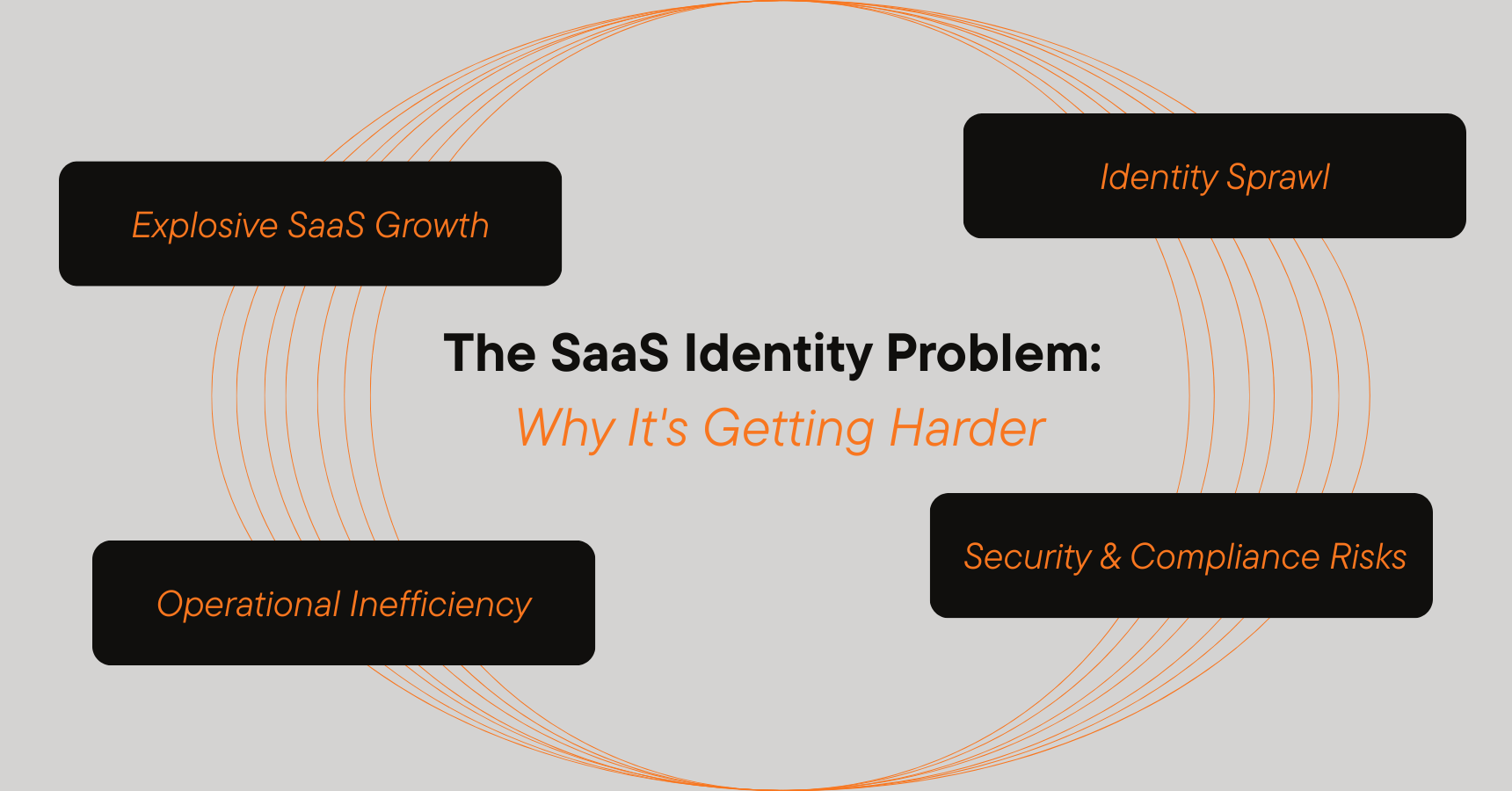
The SaaS Identity Problem: Why It's Getting Harder
Organizations face mounting challenges as their SaaS environments expand rapidly, creating complex webs of user identities, access rights, and security vulnerabilities. Traditional identity and access management approaches struggle to keep pace with the scale and complexity of modern cloud applications.
Explosive SaaS Growth
The average enterprise now uses over 130 SaaS applications, representing a 30% increase from just two years ago. This rapid adoption creates a complex ecosystem where each application maintains its own user directories and access controls.
IT teams struggle to maintain visibility across this expanding landscape. New applications get deployed without proper integration into existing identity governance and administration frameworks. Shadow IT further complicates the picture, with departments purchasing and deploying SaaS tools independently.
Each new application introduces unique authentication mechanisms and authorization models. Some rely on SAML, others use OAuth, and many still depend on basic username-password combinations. This fragmentation makes centralized identity management increasingly difficult.
The proliferation creates significant overhead for IT administrators. They must manually configure access policies, user provisioning, and deprovisioning processes for each platform separately.
Identity Sprawl
Users accumulate multiple digital identities across different SaaS platforms, often with varying access levels and permissions. A single employee might have accounts in productivity suites, CRM systems, project management tools, and specialized industry applications.
This multiplication of identities creates inconsistent access patterns. The same user may have administrative privileges in one system while having restricted access in another, despite identical job requirements.
Common identity proliferation patterns:
Multiple accounts for the same user across platforms
Orphaned accounts from former employees
Service accounts with unclear ownership
Shared credentials for team-based applications
Identity governance and administration systems often lack real-time synchronization capabilities. When employees change roles or leave the organization, their access rights may persist across multiple platforms, creating security vulnerabilities.
Manual identity lifecycle management becomes unsustainable at scale. IT teams cannot efficiently track, update, or revoke access across dozens or hundreds of applications.
Security & Compliance Risks
Fragmented identity management creates significant security gaps that attackers can exploit. Each unsecured or poorly managed identity represents a potential entry point into organizational systems.
Compliance frameworks like SOX, GDPR, and HIPAA require strict access controls and audit trails. Organizations struggle to demonstrate compliance when user access spans multiple disconnected systems.
Key security vulnerabilities include:
Excessive permissions: Users retain access to applications they no longer need
Weak authentication: Inconsistent password policies and lack of multi-factor authentication
Poor visibility: Limited insight into who has access to what data across platforms
Data breaches often result from compromised identities with elevated privileges. When attackers gain access to one system, they can potentially pivot to other connected applications.
Audit preparation becomes resource-intensive without centralized identity governance. Organizations must manually collect access logs and permission reports from each individual SaaS platform.
Operational Inefficiency
Manual identity management processes consume significant IT resources and slow business operations. Provisioning new user accounts across multiple systems can take days or weeks, delaying employee productivity.
Help desk tickets related to access issues increase dramatically as SaaS adoption grows. Password resets, permission requests, and access troubleshooting consume valuable IT support time.
User experience suffers when employees must remember multiple credentials and navigate different authentication processes. This complexity often leads to security-compromising behaviors like password reuse or credential sharing.
Operational challenges include:
Lengthy onboarding processes for new employees
Complex offboarding procedures with multiple manual steps
Frequent access-related support requests
Time-consuming access reviews and recertification processes
Cost implications extend beyond IT labor. Organizations often pay for unused licenses when deprovisioning processes fail or lag behind employee departures.
Smarter SaaS Governance with AI
AI transforms traditional governance approaches by delivering automated policy enforcement and intelligent risk detection across SaaS environments. Organizations gain continuous oversight capabilities that adapt to changing security requirements while reducing manual intervention demands.
AI as the Always-on Governance Assistant
AI systems monitor SaaS environments continuously, enforcing security policies without human intervention. These systems detect policy violations in real-time and automatically trigger corrective actions.
The technology analyzes user behavior patterns to identify anomalous activities that traditional rule-based systems miss. AI governance assistants learn from historical data to improve detection accuracy over time.
Key automation capabilities include:
Policy violation detection
Access request processing
Compliance monitoring
Risk assessment updates
AI assistants handle routine governance tasks like access reviews and offboarding processes. They flag high-risk situations for human review while managing standard operations independently.
How It Reduces Human Error While Scaling Oversight
Manual governance processes create bottlenecks and increase error rates as SaaS portfolios expand. AI eliminates human oversight limitations by processing thousands of access decisions simultaneously.
The technology ensures consistent policy application across all applications and users. Role-based access control (RBAC) rules execute uniformly without subjective interpretation variations.
Error reduction occurs through:
Automated rule enforcement
Standardized decision-making
Consistent policy application
Reduced manual processing
AI scales oversight capabilities beyond human capacity limitations. Organizations monitor hundreds of SaaS applications with the same governance rigor previously possible for only a few critical systems.
Real-time Analytics
AI-powered analytics provide immediate visibility into governance health and security posture. Dashboards display current compliance status, access anomalies, and policy violations as they occur.
The technology generates automated reporting for compliance audits and stakeholder reviews. Real-time insights enable rapid response to insider threats and unauthorized access attempts.
Continuous monitoring supports zero trust architecture principles by validating user permissions constantly. AI analytics identify drift from established security baselines and recommend corrective actions immediately.
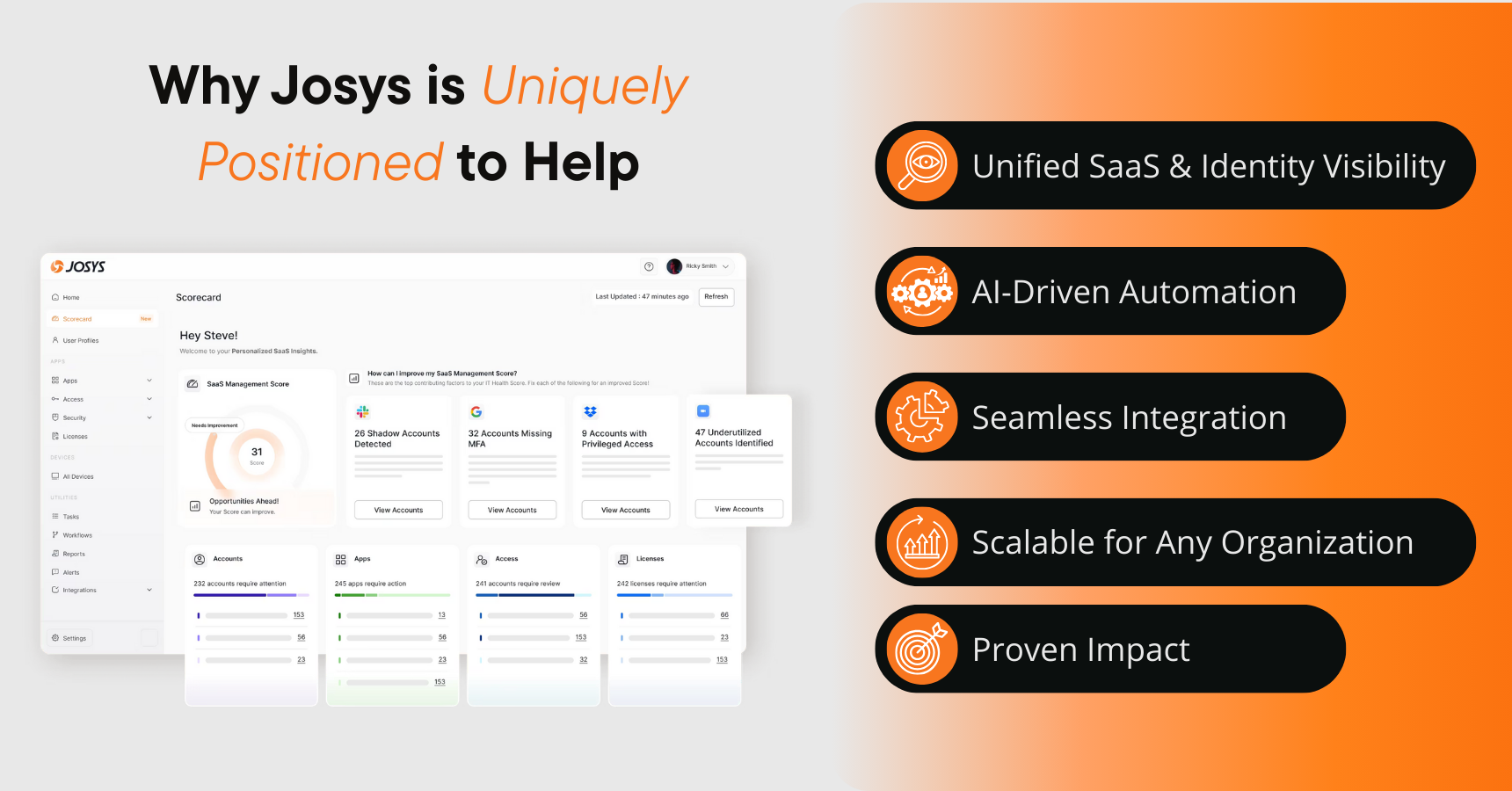
Why Josys is Uniquely Positioned to Help
Josys combines comprehensive SaaS discovery with advanced identity governance capabilities through AI-driven automation. The platform integrates seamlessly with existing infrastructure while scaling to meet organizational needs of any size.
Unified SaaS & Identity Visibility
Josys provides complete visibility across all SaaS applications and user identities in a single dashboard. The platform automatically discovers shadow IT applications that traditional tools miss.
Organizations can track user access patterns across their entire SaaS ecosystem. This includes monitoring which applications employees use, when they access them, and what permissions they hold.
Real-time discovery capabilities include:
Automated detection of new SaaS applications
User access mapping across all platforms
Permission-level visibility for each application
Integration with existing identity providers
The platform identifies redundant applications and unused licenses within minutes of deployment. Teams gain immediate insights into their complete digital identity landscape without manual audits or lengthy discovery processes.
The platform's AI continuously monitors identity lifecycle management processes. It flags potential security risks before they become incidents and recommends immediate remediation steps.
Machine learning algorithms adapt to each organization's unique access patterns. This reduces false positives while maintaining strict security controls across all managed applications.
Seamless Integration
Josys connects with existing identity providers and SaaS management tools through pre-built connectors. Organizations can deploy the platform without disrupting current workflows or requiring extensive IT resources.
The platform supports major identity providers including Azure AD, Okta, and Google Workspace. Integration typically completes within hours rather than weeks.
Integration capabilities:
SSO provider connections
HRMS system synchronization
IT service management platforms
Security information and event management tools
Native APIs enable custom integrations for specialized business applications. The platform maintains data consistency across all connected systems without requiring manual synchronization.
Scalable for Any Organization
Josys architecture scales from small teams to enterprise organizations with thousands of users. The platform handles increased application volume and user growth without performance degradation.
Multi-tenant capabilities support complex organizational structures. Subsidiaries and departments can maintain separate governance policies while providing centralized oversight.
Scalability features:
Horizontal scaling for large user bases
Regional deployment options
Customizable governance frameworks
Flexible licensing models
The platform processes millions of identity events daily across customer environments. Performance remains consistent regardless of organizational size or application complexity.
Proven Impact
Organizations using Josys report significant improvements in identity governance efficiency and security posture. The platform typically reduces manual identity management tasks by 70% within the first quarter of deployment.
Measurable outcomes include:
40% reduction in unused software licenses
60% faster access reviews and certifications
80% decrease in identity-related security incidents
90% improvement in compliance audit preparation time
Companies achieve full visibility into their SaaS environments within days of implementation. The platform's AI-driven IAM capabilities enable proactive risk management rather than reactive incident response.
The Business Case for AI-Powered Identity Management
Organizations investing in AI-powered identity management typically see immediate returns through reduced security incidents, streamlined operations, and lower administrative costs. These systems deliver measurable improvements in compliance adherence while enhancing the daily experience for employees accessing business applications.
Security ROI
AI-powered identity management systems reduce security incidents by an average of 65% within the first year of implementation. Organizations experience fewer data breaches, unauthorized access attempts, and compliance violations.
The technology identifies suspicious login patterns and risky user behaviors that traditional systems miss. Machine learning algorithms analyze user access patterns across multiple applications simultaneously. This real-time analysis prevents security threats before they escalate.
Financial impact includes:
Reduced incident response costs
Lower cybersecurity insurance premiums
Decreased regulatory fines
Minimized business disruption expenses
Operational Efficiency
AI automation eliminates 80% of manual identity management tasks that IT teams previously handled. Automated provisioning and deprovisioning reduce the time to grant new employee access from days to minutes.
The systems automatically assign appropriate permissions based on job roles and department requirements. User access reviews that once took weeks now complete in hours with AI-driven recommendations.
IT teams redirect their focus from routine administration to strategic security initiatives, improving overall security posture while reducing operational overhead.
Cost Optimization
Organizations reduce identity management costs by 40-60% through AI automation and improved resource allocation. The technology eliminates redundant software licenses by identifying unused applications and duplicate user accounts.
AI systems provide detailed usage analytics that reveal which applications employees actually use versus what organizations pay for. This data enables informed decisions about software renewals and contract negotiations.
Cost reduction areas:
Software license optimization
Reduced administrative overhead
Lower compliance audit costs
Decreased security incident expenses
Employee Experience
AI-powered single sign-on capabilities reduce the number of passwords employees must remember from an average of 25 to just one. This simplification decreases password reset requests by 85% and improves productivity.
Employees gain faster access to necessary applications without lengthy approval processes. The system learns user patterns and pre-approves routine access requests based on role requirements and historical usage.
Smart recommendations suggest relevant applications based on job function and team membership. This proactive approach helps employees discover tools that improve their work efficiency.
The streamlined experience reduces frustration and increases adoption rates for new business applications. Employees report 40% less time spent on authentication-related tasks throughout their workday.
Conclusion
AI-powered identity management is no longer a “nice to have” but a critical capability for organizations drowning in SaaS sprawl, identity silos, and compliance risk. By automating provisioning, detecting anomalies, and streamlining governance, companies can eliminate orphaned accounts, shrink attack surfaces, and ensure access aligns with actual business needs.
The benefits extend beyond security—operational efficiency improves as onboarding accelerates, license waste decreases, and IT teams are freed from repetitive identity tasks. With machine learning providing real-time insights, organizations can move from reactive to proactive governance while maintaining compliance with ease.
Platforms like Josys deliver these capabilities at scale, combining SaaS discovery, AI-driven policy enforcement, and seamless integrations to give businesses a single source of truth for all identities.
For enterprises facing mounting complexity, the path forward is clear: intelligent, automated identity governance that adapts as fast as your SaaS environment evolves.