This site uses third-party website tracking technologies to provide and continually improve our services, and to display advertisements according to users' interests. I agree and may revoke or change my consent at any time with effect for the future.
If you're an MSP working with defense contractors or government clients, you've likely encountered the term CMMC, Cybersecurity Maturity Model Certification. It's more than just another compliance acronym. CMMC represents a fundamental shift in how the Department of Defense (DoD) protects sensitive information throughout its supply chain, and it directly impacts how you serve your clients.
For MSPs, CMMC presents both a challenge and an opportunity. On one hand, navigating the certification requirements can feel overwhelming. On the other hand, positioning your services to support CMMC compliance opens doors to a growing market of defense contractors who need expert guidance. As of late 2025, only 0.5% had achieved Level 2 certification. This article breaks down what CMMC means for your MSP, when you need certification yourself, and how to turn compliance into a competitive advantage.
Why CMMC Compliance Matters in the United States
The DoD introduced CMMC to address a critical vulnerability: cyberattacks targeting the Defense Industrial Base (DIB). When contractors handle Controlled Unclassified Information (CUI) or Federal Contract Information (FCI), they become potential entry points for adversaries. Traditional self-attestation models weren't enough, the DoD needed verified, third-party assessments to ensure cybersecurity standards were actually being met.
CMMC standardizes cybersecurity requirements across the entire defense supply chain, which comprises more than 100,000 companies. Instead of each contractor implementing security measures inconsistently, CMMC creates a unified framework based on NIST SP 800-171 and other standards. For MSPs, this means your defense contractor clients can't simply claim they're secure anymore, non-compliant contractors are ineligible for awards and must prove compliance through formal certification.
Who Needs to Adhere to CMMC?
Any organization bidding on DoD contracts that involve CUI or FCI must achieve CMMC certification. This includes prime contractors, subcontractors, and even suppliers several tiers down the supply chain. The certification level required depends on the sensitivity of the information being handled.
Here's where it gets interesting for MSPs: you don't automatically need CMMC certification just because you serve government clients. The requirement is triggered by specific conditions related to how you handle, process, or store CUI on behalf of your defense contractor clients.
When MSPs/MSSPs Do Need to Pursue CMMC Level 2
Your MSP needs CMMC Level 2 certification when you meet these criteria:
You process, store, or transmit CUI for defense contractors in your systems or infrastructure
You have administrative access to environments where CUI resides
You manage security controls that protect CUI on behalf of your clients
Your clients' contracts flow down CMMC requirements to their service providers
For example, if you're hosting email servers, managing cloud environments, or providing endpoint management that touches CUI, you're in scope. However, if you're only providing consulting services without direct access to CUI systems, you may not need certification yourself, though you'll still need deep CMMC knowledge to guide your clients effectively.
How MSPs Can Offer CMMC as a Service
The MSP's Role During a CMMC Level 2 Assessment
When your defense contractor clients pursue CMMC Level 2, you become a critical partner in their success. Your role typically includes:
Gap analysis and remediation: Assess current security posture against CMMC requirements and implement necessary controls
Documentation and evidence collection: Help clients create and maintain the policies, procedures, and evidence required for assessment
System Security Plan (SSP) development: Document the security boundary, data flows, and implemented controls
Technical implementation: Configure and manage security tools that satisfy CMMC requirements
Ongoing monitoring and maintenance: Ensure controls remain effective between assessments
The assessment itself focuses on 110 security practices across 14 domains. Your clients need to demonstrate not just that controls exist, but that they're implemented correctly and operating effectively. This is where your technical expertise becomes invaluable, assessors will verify configurations, review logs, and test controls in real-world scenarios.
Partnering with Third-Party Assessors: What to Expect
CMMC Level 2 requires assessment by a CMMC Third-Party Assessment Organization (C3PAO). As an MSP, understanding the assessment process helps you prepare clients more effectively.
The C3PAO will conduct both document reviews and technical testing. They'll interview your client's personnel, examine security configurations, and validate that documentation matches reality. Assessments typically take several days depending on the organization's size and complexity.
Pro tip: Build relationships with C3PAOs before your clients need assessments. Understanding their expectations and common findings helps you implement controls correctly the first time, reducing costly remediation cycles.
CMMC Levels Explained: What Each Means for Your MSP
Overview of CMMC Maturity Levels
CMMC 2.0 simplified the original five-level model into three levels:
Level 1 (Foundational): Covers basic cybersecurity hygiene aligned with FAR 52.204-21. It includes 17 practices focused on protecting Federal Contract Information. Level 1 allows for self-assessment in most cases.
Level 2 (Advanced): Implements all 110 practices from NIST SP 800-171, designed to protect Controlled Unclassified Information. This level requires third-party assessment and represents the standard for most DoD contracts involving CUI.
Level 3 (Expert): Adds enhanced security practices for the most sensitive programs. Level 3 is reserved for a small subset of high-priority contracts and requires government-led assessment.
How to Determine Which CMMC Level Applies to Your MSP Services
The CMMC level you need depends on your clients' contracts, not your own business type. Start by asking these questions:
What types of information do your defense contractor clients handle?
Does your service delivery model require access to client systems containing CUI?
Are you providing managed services within the security boundary of a contractor's CMMC scope?
Do client contracts explicitly flow down CMMC requirements to subcontractors and service providers?
Most MSPs serving defense contractors will encounter Level 2 requirements. If you're unsure, review your service agreements and have conversations with clients about their CMMC obligations. It's better to pursue certification proactively than to discover you're non-compliant when a client faces an assessment.
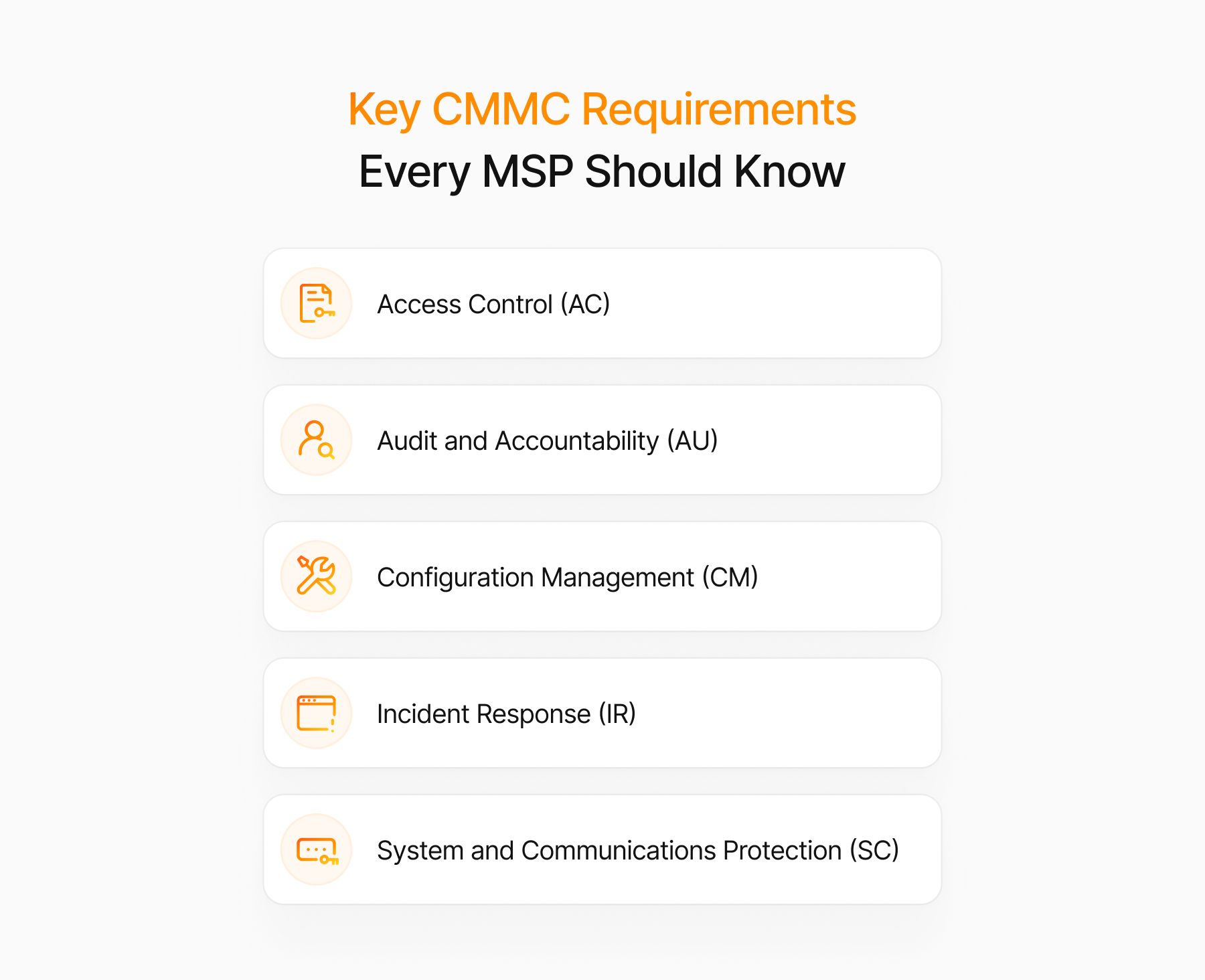
Key CMMC Requirements Every MSP Should Know
While CMMC Level 2 includes 110 practices, certain requirements consistently challenge MSPs. Understanding these upfront saves time and prevents common pitfalls:
Access Control (AC): You need robust identity and access management, including multi-factor authentication, least privilege principles, and regular access reviews. For MSPs managing multiple client environments, this means implementing strong tenant separation and privileged access management.
Audit and Accountability (AU): Comprehensive logging and monitoring are non-negotiable. You must capture security-relevant events, protect log integrity, and review logs regularly. Many MSPs underestimate the scope of logging required, it's not just security tools, but system access, configuration changes, and administrative actions.
Configuration Management (CM): Baseline configurations, change control processes, and security configuration enforcement are essential. This is particularly relevant for MSPs using tools to manage client endpoints and infrastructure, your configuration management processes become part of the compliance picture.
Incident Response (IR): You need documented incident response plans, trained personnel, and the ability to detect and respond to security incidents. For MSPs, this extends to incidents affecting client CUI, requiring clear communication protocols and coordinated response procedures.
System and Communications Protection (SC): Boundary protection, encryption, and secure communications are foundational. If you're managing networks or cloud environments for defense contractors, your architecture must support proper segmentation and encryption of CUI at rest and in transit.
How MSPs Leverage Josys for CMMC Compliance
Meeting CMMC requirements demands visibility and control across your entire IT environment and your clients' environments. This is where Josys becomes a force multiplier for MSPs pursuing or supporting CMMC compliance.
Josys provides centralized identity, SaaS, and device management that directly addresses several CMMC control families. For access control requirements, Josys gives you a single pane of glass to manage user access across multiple SaaS applications, making it easier to enforce least privilege and conduct regular access reviews. When an employee leaves or changes roles, you can quickly identify and revoke unnecessary access, a critical capability for CMMC's personnel security requirements.
For configuration management and audit requirements, Josys automatically tracks software inventory, license usage, and configuration changes across your managed environment. This visibility is essential for maintaining accurate system inventories (as required under CMMC) and for demonstrating that you know what's running in your environment. The platform's audit trails provide the evidence that assessors look for when validating your compliance posture.
Perhaps most valuable for MSPs is how Josys streamlines multi-tenant management. When you're supporting multiple defense contractor clients, each with their own CMMC requirements, maintaining separation and proper controls can become overwhelming. Josys helps you manage each client environment independently while maintaining the security boundaries assessors expect to see.
The platform also supports the ongoing compliance burden, CMMC isn't a one-time assessment but a continuous commitment. Josys's automation capabilities reduce the manual effort required to maintain compliant configurations, monitor access, and generate reports for internal reviews or client requests.
Simplify your path to CMMC
CMMC represents a significant shift in how defense contractors, and the MSPs that serve them, approach cybersecurity. While the certification requirements may seem daunting, they also create clear differentiation for MSPs willing to invest in compliance. By understanding when you need certification, what each level requires, and how to position CMMC as a service offering, you can turn regulatory complexity into competitive advantage. The key is starting early, building the right processes and tools, and treating compliance as an ongoing practice rather than a checkbox exercise.
Ready to streamline your CMMC compliance journey? Josys helps MSPs maintain visibility, control, and audit readiness across their entire IT environment. Book a demo to see how our platform can simplify your path to CMMC certification while improving how you serve defense contractor clients.
Questions
When do new CMMC requirements take effect for MSPs in the US?
CMMC requirements are being phased into DoD contracts gradually. The DoD began including CMMC requirements in new contract solicitations in 2024, with full implementation expected to continue through 2026. However, the timeline varies by contract type and classification level. MSPs should monitor their clients' contract awards and renewal dates, as CMMC requirements will appear in contract language when applicable. If you're currently serving defense contractors, start preparing now, waiting until a client faces an imminent assessment creates unnecessary risk and rushed implementation.
Are there CMMC compliance tools or software suites recommended for MSPs?
While the CMMC Accreditation Body doesn't officially endorse specific tools, successful CMMC compliance typically requires a suite of security and management solutions. Essential categories include endpoint detection and response (EDR), security information and event management (SIEM), identity and access management (IAM), and SaaS management platforms. Josys addresses the SaaS and device management components, providing visibility and control that support multiple CMMC requirements. The key is choosing tools that not only provide security capabilities but also generate the audit evidence and documentation assessors require. Look for platforms with robust logging, reporting, and configuration management features.
Does every MSP need CMMC certification to serve government clients?
No. CMMC certification is only required when you process, store, or transmit CUI for defense contractors, or when you have administrative access to systems containing CUI. If you provide advisory services, training, or support that doesn't involve direct access to CUI systems, you likely don't need certification yourself. However, you'll still need deep CMMC knowledge to guide clients effectively. Even if certification isn't required for your MSP, understanding CMMC positions you as a valuable partner to defense contractors navigating their own compliance journeys. Always review your service delivery model and client contracts to determine your specific obligations.