This site uses third-party website tracking technologies to provide and continually improve our services, and to display advertisements according to users' interests. I agree and may revoke or change my consent at any time with effect for the future.
TL;DR:The top 9 software license management tools for 2026, with guidance on optimizing costs and compliance. Covers license types, key features, and best practices.
Software license management starts with identity. Every license assignment, access grant, and unused seat traces back to who holds it, so the real problem is rarely the spreadsheet. It's the disconnect between who has access and what you're paying for.
With the average enterprise now managing hundreds of applications across human users, machine accounts, and AI agents, the right license management tool is essential for controlling costs, reducing risk, and proving value. This guide examines the top software license management solutions so you can find the ideal fit for your organization.
Key Takeaways
License management is now a strategic discipline spanning cost, compliance, and security, not just tracking serial numbers.
Identity governance is the foundation: you cannot optimize licenses without knowing exactly which identities hold them.
Modern tooling splits into traditional SAM platforms for on-premises software and SaaS-native platforms for cloud apps; hybrid estates need both.
Org-wide control depends on centralized visibility and shared ownership. Flexera's 2026 State of ITAM Report finds 66% of organizations have SaaS visibility.
AI-native platforms unify identity governance and license management, automating policy enforcement across human users, machine accounts, and AI agents.
What is SaaS license management?
SaaS license management is how you keep track of your subscription software: who has a seat, whether they use it, what plan they're on, and when the contract renews. It's the part of software license management that covers cloud apps, where a license is access for a person rather than a copy installed on a machine.
That changes what you have to check. With on-premise software, the question is whether you're inside your contract. With SaaS, the question is whether the person still needs the seat and whether they need that plan. The first needs an inventory. The second needs usage data tied to each user.
Get this right and you spend less, stay ready for audits, and close the gaps that untracked apps and forgotten accounts leave open.
Top License Management Tools
License management has moved past simple tracking. Today's tools must deliver 360-degree control, optimize operations, and empower IT teams to focus on strategic initiatives. After evaluating solutions based on innovation, control, and efficiency, these nine platforms stand out as the leaders reshaping how IT teams manage software.
1. Josys
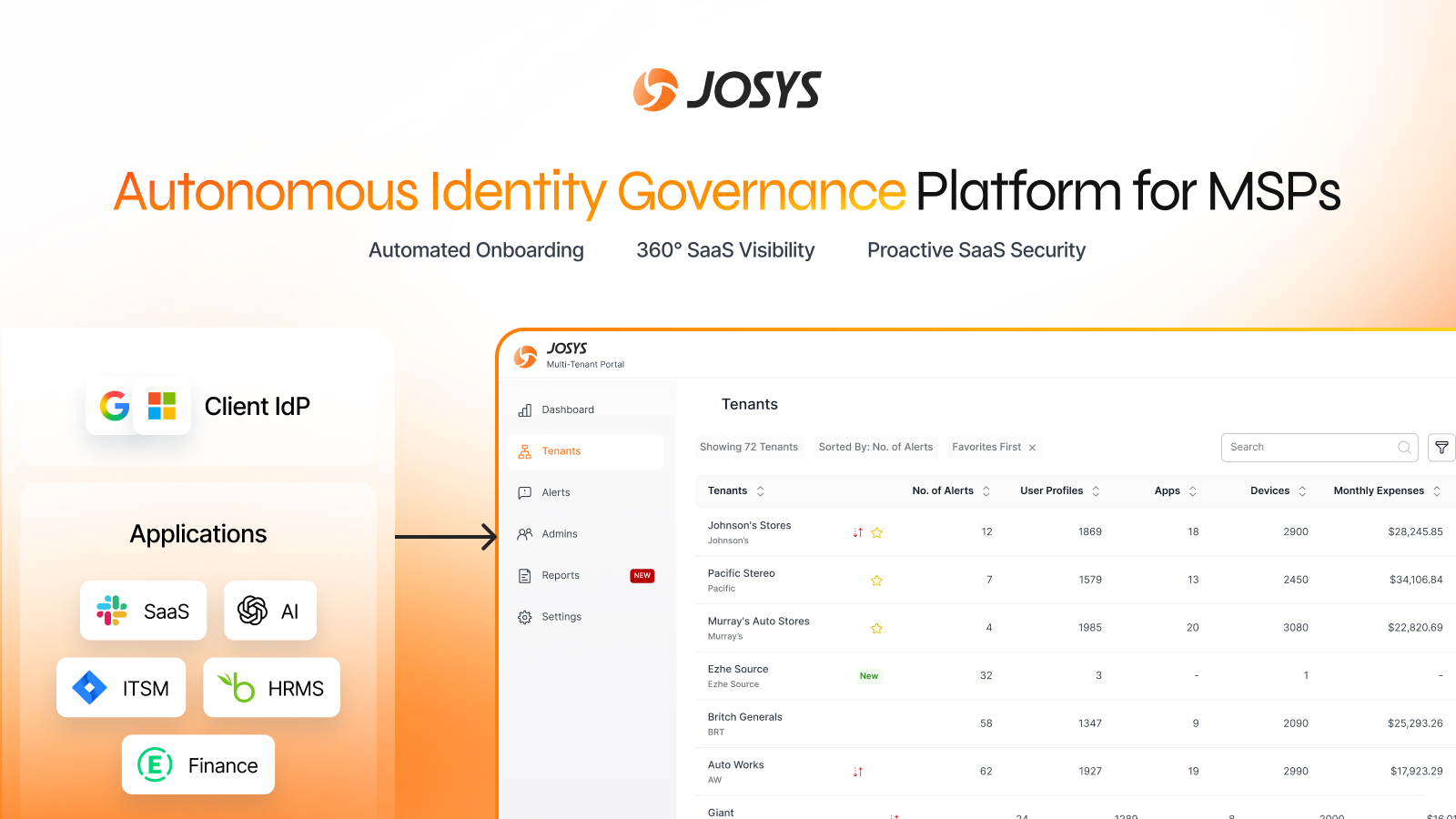
Josys is the best choice for teams that want unified software license management and AI-native identity governance in a single platform. We go beyond basic license tracking by anchoring every license decision to identity. This means you see exactly who, human, machine, or AI agent, holds each license and whether they're actually using it.
Key Features:
Centralized dashboard for all SaaS applications, licenses, and identities
Policy-led governance that enforces access rules autonomously
Automated user onboarding and offboarding across multiple applications
Real-time utilization tracking and optimization recommendations
Cost management to identify savings opportunities and reduce manual workloads
Best For: Organizations with significant SaaS investments looking to unify identity governance with license optimization, improve security, and cut manual workloads.
Real-World Impact: Companies using Josys have reported up to 20% reductions in monthly user costs within the first several months by identifying unused licenses. Innovation consultancy Mach49 achieved significant cost savings while transforming offboarding from a manual, error-prone workflow to an automated system that eliminated compliance risks.
The other eight leaders each suit a different environment:
Tool
Best for
Standout strength
FlexNet Manager Suite by Flexera
Large enterprises with complex, high-stakes licensing
Deep coverage of intricate on-premises and cloud models from vendors like Microsoft, Oracle, and IBM
Snow License Manager
Mid-size to large orgs wanting power plus ease of use
A large software recognition library and strong analytics across on-premises, cloud, and SaaS
ManageEngine AssetExplorer
Small to mid-sized teams with limited SAM resources
Affordable, integrated software and hardware asset management with quick time-to-value
ServiceNow Software Asset Management
Organizations already invested in ServiceNow
Tight ITSM and ITOM integration with powerful workflow automation
Ivanti License Optimizer
Complex licensing environments needing deep analysis
Detailed optimization and scenario modeling across traditional and cloud
Certero for Enterprise SAM
Teams wanting one unified SAM platform
Single-platform architecture and a single source of truth across on-premises, cloud, and mobile
Zluri
Orgs with large SaaS portfolios and sprawl
Automated SaaS discovery, user lifecycle management, and spend optimization
OpenLM
Engineering-heavy orgs using floating licenses
Real-time monitoring and license harvesting for CAD, simulation, and analysis tools
Types of Software Licenses
Software licenses fall into five main models, and knowing which ones you hold is the first step to controlling their cost. Modern licensing has moved far beyond simple one-time purchases, creating a complex mix that demands 360-degree control.
License model
What it is
Watch out for
Perpetual
A one-time purchase to use a specific software version indefinitely
Legacy sprawl and recurring support costs; these still need active management
Subscription
Recurring fees for ongoing access to the latest features and updates
Budget creep as seats and tiers scale over time
User-based vs. device-based
Access tied to specific individuals (user) or to specific machines (device)
Many orgs run both at once, which clouds visibility and compliance
Consumption-based
Charges based on actual usage, such as compute, storage, or API calls
Unpredictable costs without constant usage monitoring
Enterprise and volume agreements
Bundled products under custom, negotiated terms
Complex deployment rights, upgrade paths, and true-ups that drive audit risk
Most organizations juggle several of these at once, which is exactly why clear visibility is non-negotiable.
License optimization: matching entitlements to reality
License optimization is the discipline of keeping what you're entitled to in line with what you actually need. It's where license management stops being record-keeping and starts returning money.
The work rests on a single comparison. On one side sit your entitlements: what your contracts permit, at what tier, for how many users. On the other sits deployment: what's assigned, to whom, at what level. The distance between the two is your license position, and almost every optimization decision follows from reading it correctly.
Knowing your license position
A license position can be wrong in two directions, and they carry very different consequences.
Over-licensed means you hold more entitlement than you deploy. The cost is purely financial and entirely recoverable - you reduce seats at renewal, or downgrade tiers, and the saving is immediate.
Under-licensed means deployment exceeds entitlement. This is the expensive direction. It surfaces during a vendor audit, and true-up pricing carries no negotiating leverage whatsoever, because by the time it's raised you have no alternative.
Most organizations are both at once, in different applications. That's why a position has to be read per vendor rather than as a single portfolio number - an aggregate view hides the exposure inside the surplus.
The four optimization levers
Once the position is accurate, four levers are available, in roughly increasing order of effort.
Tier right-sizing. Move users to the lowest tier that covers what they do. Nobody loses access, so this meets the least resistance of anything on the list. It is also usually the largest single saving, because tiers are typically set once at purchase by whoever needed the most advanced feature, and everyone else inherits it.
Harvesting and reassignment. Recover seats from inactive accounts and redirect them to people waiting for access rather than buying new ones. For full detail on identifying which seats qualify, see our guide to SaaS spend management.
License model changes. Some vendors offer both per-user and consumption pricing. Where usage is concentrated in a small group, or spiky rather than steady, the model itself may be costing you more than the volume does.
Portfolio consolidation. Where two applications cover the same ground, standardizing on one converts two mid-size contracts into one larger one - usually at a better unit rate, and always with less administration.
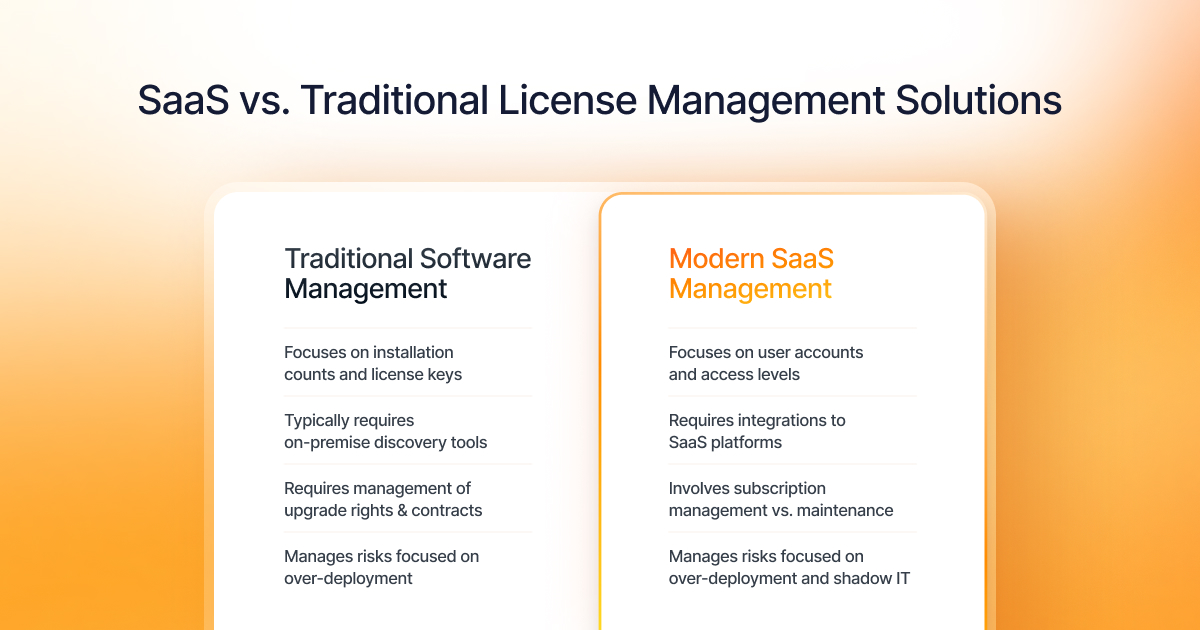
SaaS vs. Traditional Software License Management Solutions
SaaS license management centers on user access and subscriptions; traditional SAM focuses on installs, keys, and maintenance contracts. Understanding these differences is essential for selecting the right approach for your environment.
Traditional software management
SaaS management
Focuses on installation counts and license keys
Focuses on user accounts and access levels
Requires on-premises discovery tools
Requires integrations to SaaS platforms
Manages upgrade rights and maintenance contracts
Manages subscriptions rather than maintenance
Risk centers on over-deployment
Risk centers on over-deployment and shadow IT
Why Identity Governance Is the Foundation of Modern License Management
License management and identity governance are converging. You cannot optimize licenses without knowing exactly who holds them, and you cannot secure identities without understanding what software access each identity carries. AI-native platforms unify both.
Policy-Led Access: Define policies once; the platform enforces them. When roles change, license assignments adjust automatically.
Full Identity Scope: Modern environments include human users, service accounts, and AI agents. Ignoring non-human identities means missing a growing share of your estate.
Autonomous Governance: AI-native platforms surface risk and remediate threats in real time, without manual oversight.
Advantages of SaaS License Management for Modern Organizations
Centralized Control: A single dashboard for managing users across applications. Josys customers report cutting provisioning time by 80-90%.
Real-Time Visibility: Near real-time usage and cost data for agile decisions. Why guess when you can know?
Continuous Optimization: Ongoing optimization, not just point-in-time compliance. Josys customers report 20-30% higher optimization rates.
Security and Compliance Considerations in SaaS Environments
SaaS environments present unique security and compliance challenges that require specialized management approaches:
Access Governance: The perimeter shifts from network to identity. Include robust governance and secure offboarding workflows.
Shadow IT Management: Unauthorized SaaS is both compliance and security risk. Discover unsanctioned shadow IT and bring it under control.
Data Sovereignty: Compliance requires visibility into data storage locations and compliance status to meet data residency requirements.
Vendor Security: Effective SaaS management includes tracking vendor security practices and compliance certifications as a core component.
How Do I Manage Software Licenses Across the Organization?
Managing software licenses org-wide requires centralized visibility, clear ownership, and automation. According to Flexera's 2026 State of ITAM Report, 66% of organizations have visibility into their SaaS environment. The same report found 78% now have a FinOps team, reflecting growing shared ownership of cost and optimization.
Here's a step-by-step approach for org-wide license management:
Centralize discovery of every app and license. Use automated tools to inventory all software, including SaaS apps adopted outside of IT procurement.
Assign clear ownership across IT, finance, and security. Establish shared accountability so each team knows its role in cost control and compliance.
Automate provisioning and deprovisioning tied to identity. Connect workflows to your IdP and HR systems so access adjusts on hire, move, or exit.
Monitor usage vs. entitlements continuously. Track consumption in real time to spot underused licenses and prevent overages.
Review and reclaim on a schedule. Set quarterly reviews to harvest idle licenses. Software cost optimization delivers its biggest returns here.
Best Practices for Software License Management and Compliance
Strong software license management depends as much on repeatable processes and governance as on the tool itself. These best practices will help you maximize the value of your license management investment.
1. Inventory and Classify All Software Assets
A comprehensive software inventory forms the foundation of effective license management. Without knowing what software you have and how it's classified, optimization and compliance become nearly impossible.
Implementation steps include:
Conduct automated discovery across all networks, devices, and cloud environments
Normalize discovered software to standardize naming and versioning
Classify applications by business criticality, risk level, and license model
Identify shadow IT through expense reports, network monitoring, and user surveys
Tie each license to an identity so you know which human, machine, or AI agent holds it
Organizations with mature, automated inventory practices keep far more accurate software records than those relying on manual processes or periodic scans, where blind spots and errors pile up fast.
2. Establish Clear Policies and Processes for Procurement
Uncontrolled software procurement leads to waste, compliance risks, and security vulnerabilities. Establishing standardized processes ensures proper evaluation, approval, and documentation of all software acquisitions.
Effective procurement governance includes:
Centralized software request process with appropriate approval workflows
Standard evaluation criteria for security, compatibility, and license terms
Preferred vendor program with pre-negotiated terms and conditions
License repository integration to automatically record new purchases
Renewal review process to evaluate continued need before automatic renewal
3. Automate License Tracking and Reporting
Manual license management doesn't scale in complex environments. Automation reduces administrative burden while improving the accuracy and timeliness of license information.
Key automation opportunities include:
License assignment workflows that provision access based on role or request
Consumption tracking that monitors actual usage against entitlements
Compliance reconciliation that automatically identifies gaps or surpluses
Renewal calendars that trigger review processes before auto-renewal dates
Executive dashboards that provide real-time visibility into license status
4. Regularly Review and Optimize License Usage
Proactive optimization is where license management delivers its greatest value. Regular reviews identify opportunities for savings and ensure alignment with evolving business needs - and they work best as part of a broader SaaS spend management process rather than as isolated license audits.
Quarterly usage reviews to identify underutilized licenses
Harvesting workflows to reclaim and reassign licenses from inactive users
License model analysis to identify opportunities to shift between licensing types
Vendor consolidation reviews to eliminate redundant applications
Renewal negotiation preparation using actual usage data as leverage
In Josys's experience, mature optimization programs can surface savings equal to 15-30% of annual software spend, though the results you actually bank depend on execution.
Conclusion
Choose a software license management platform that fits your environment, then pair it with strong identity governance to cut cost and risk. The best solutions in 2026 treat identity as the control plane, so every access decision and license assignment traces to a governed identity. Don't buy the prettiest feature grid; buy the tool that matches your stack, automates the grunt work, and pairs technology with clear ownership.
Ready to unify license management and identity governance? Schedule a demo today to see how Josys can help you gain control over your software assets, reduce costs, and eliminate compliance risks.
FAQ
These FAQs answer the most common software license management questions.
What Is Software License Management?
Software license management is the process of tracking, controlling, and optimizing all software licenses an organization owns or uses. It encompasses documenting entitlements, monitoring actual usage, and ensuring compliance with vendor agreements. Effective software license management reduces audit risk, eliminates wasted spend, and provides the visibility needed for informed procurement decisions.
What is the difference between SaaS license management and software license management?
Software license management is the broader discipline, covering on-premise licences, perpetual agreements and maintenance contracts alongside cloud subscriptions. SaaS license management is the subset dealing specifically with subscription software: per-seat assignments, usage against entitlement, tier right-sizing and renewals. The practical difference is that SaaS licences are tied to identities rather than installations, so managing them is an access problem.
What Are the Main Types of Software Licenses?
The five primary license models are perpetual, subscription, user-based, device-based, and consumption-based. Perpetual licenses require a one-time purchase. Subscription licenses require recurring payments. User-based licenses tie to individuals, device-based to machines, and consumption-based to actual usage. Enterprise agreements bundle multiple products under negotiated terms.
How Does Software License Management Reduce Software Costs?
Software license management reduces costs by identifying unused licenses that can be reclaimed and reassigned. It prevents over-purchasing at renewal time and flags duplicate apps across departments. Usage data strengthens your negotiating position with vendors, and automated harvesting reclaims licenses from inactive users.
What's the Difference Between a License Management Tool and a SaaS Management Platform?
Traditional software license management tools focus on on-premises software: tracking installations, keys, and maintenance contracts. SaaS management platforms focus on cloud applications: monitoring user accounts, subscription tiers, and access levels. Organizations with hybrid environments often need both types of solutions working together.
Why Is Identity Governance Connected to License Management?
Every license is tied to an identity. When identities are managed poorly, licenses drift: departed employees keep access, role changes don't trigger reassignment, and orphaned accounts accumulate unused seats. Identity governance ensures licenses flow to the right people at the right time, and AI-native platforms automate this across human users, service accounts, and AI agents.
How do I reclaim unused SaaS licenses?
Compare seats assigned against seats with meaningful activity over the last 90 days. Split the result into zero-activity seats (reclaim immediately), low-activity seats (review with the owning manager) and over-licensed seats (downgrade the tier). Then tie revocation to your offboarding process so departed employees release licences automatically rather than at the next audit.