This site uses third-party website tracking technologies to provide and continually improve our services, and to display advertisements according to users' interests. I agree and may revoke or change my consent at any time with effect for the future.
Centralized identity management is the foundational solution to SaaS sprawl, empowering organizations to maintain visibility and control over user access throughout their entire application ecosystem. Without adopting a centralized approach, companies encounter heightened security risks, compliance hurdles, and escalating administrative burdens.
This comprehensive guide examines how organizations can address identity management challenges through strategic centralization. It explores the role of specialized platforms in streamlining these processes and provides practical steps for implementing effective solutions.
Key Takeaways
SaaS sprawl leads to identity management chaos, increasing security risks and operational complexity
Centralized identity management forms the foundation for controlling access across multiple applications
As SaaS applications proliferate across departments, organizations find it increasingly challenging to maintain visibility and control over user identities. This fragmentation introduces security vulnerabilities, compliance gaps, and operational bottlenecks that traditional identity management strategies struggle to resolve.
Definition: SaaS Sprawl
SaaS sprawl describes the unchecked growth of software-as-a-service applications within an organization. Employees often adopt new SaaS platforms without IT oversight, resulting in a tangled web of disconnected services.
Most enterprises use between 80 and 400 different SaaS applications. Departments frequently select their own tools for project management, communication, file sharing, and specialized workflows.
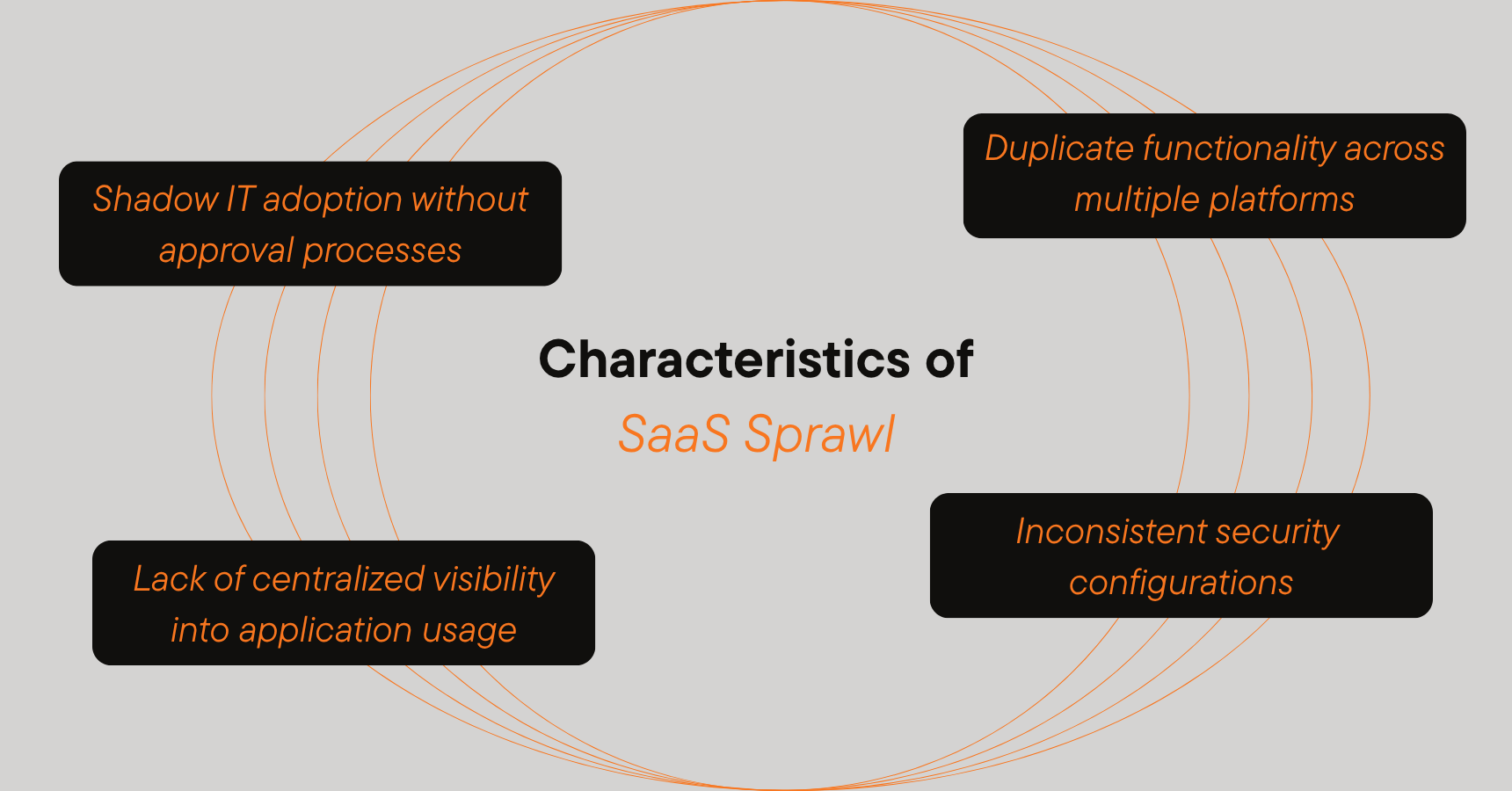
Common characteristics of SaaS sprawl include:
Shadow IT adoption without approval processes
Duplicate functionality across multiple platforms
Inconsistent security configurations
Lack of centralized visibility into application usage
This expansion typically occurs organically as teams seek productivity gains. However, it creates significant challenges for identity management and access control throughout the technology stack.
Common Identity Challenges
When each SaaS application maintains its own user directory, identity management becomes fragmented. IT teams lose sight of who has access to which systems and data.
Password fatigue sets in as users juggle dozens of unique credentials, often leading them to reuse passwords or choose weak ones to simplify their login experience.
Key identity management problems include:
Multiple identity stores with inconsistent user data
Manual provisioning and deprovisioning processes
Inability to enforce consistent access policies
Limited audit trails across SaaS platforms
Managing the user lifecycle becomes nearly impossible at scale. When employees change roles or leave the organization, IT struggles to efficiently update or revoke access across all SaaS applications.
Cybersecurity risks escalate when organizations lack the ability to control or monitor user access across SaaS platforms. Attackers exploit weak credentials and orphaned accounts to gain unauthorized entry.
Data breaches frequently stem from excessive user permissions or accounts that remain active after employees depart. Every additional SaaS application increases the potential attack surface.
Security risks include:
Credential stuffing attacks across multiple platforms
Privileged access without proper oversight
Data exfiltration through unsecured SaaS applications
Meeting compliance requirements becomes increasingly difficult without centralized identity controls. Regulations such as SOX, HIPAA, and GDPR demand detailed access logging and regular access reviews.
Operational inefficiency drains IT resources as teams handle manual identity management tasks. Help desk tickets rise as users grapple with multiple login credentials and forgotten passwords.
Why Centralization is The Key First Step
For organizations with dispersed SaaS applications, authentication complexity and security vulnerabilities grow with each new platform. Centralized identity management establishes a single point of control for user access across all applications, enabling the enforcement of consistent security policies.
What Centralization Means in Identity Management
Centralization in identity management involves consolidating all user authentication and authorization processes into a unified system. This approach replaces the need for multiple login credentials across different SaaS applications with a single access point.
The central system serves as the single source of truth for user identities, managing who has access to which applications and specifying permissions within each platform.
Identity and access management (IAM) platforms fulfill this central role by connecting to all SaaS applications through standardized protocols such as SAML or OAuth.
Single sign-on (SSO) is the most visible benefit of centralization, allowing users to authenticate once and access all authorized applications without repeated logins.
With this shift, the IT infrastructure moves from managing numerous isolated identity silos to overseeing one comprehensive system. This consolidation removes the need to track user accounts across multiple platforms individually.
Benefits of Centralizing SaaS Identities
Centralized identity management mitigates security risks by preventing password reuse across platforms. Organizations gain complete visibility into user access patterns, enabling rapid identification of suspicious activity.
Administrative efficiency is greatly enhanced, as IT teams can manage identities from a single location. Adding new users or removing departing employees becomes a one-step process, rather than a repetitive task across numerous applications.
Scalability improves as organizations introduce new SaaS tools. Each new application integrates with the existing identity system, avoiding the creation of additional authentication silos.
Identity security is strengthened through the consistent enforcement of policies. Organizations can apply uniform access controls, password requirements, and multi-factor authentication across all connected applications.
Compliance reporting is simplified when all access data is centralized. Auditors can easily review user permissions and access logs from a single dashboard, eliminating the need to gather information from multiple sources.
The Role of SaaS Management Platforms (SMPs) in Identity Centralization
SaaS management platforms bridge the gap between distributed applications and centralized identity governance by offering automated discovery, unified access controls, and comprehensive monitoring capabilities. These platforms transform fragmented identity environments into cohesive, manageable ecosystems.
How SMPs Act as the Central Hub for SaaS Governance
SMPs serve as the command center for identity operations across an organization's entire SaaS portfolio. They automatically discover shadow IT applications and map existing user access patterns.
By consolidating identity data from multiple sources into a single dashboard, security teams gain clear visibility into who has access to which applications and when permissions were granted.
SMPs integrate with identity providers like Active Directory and Okta, creating a unified identity fabric that encompasses both sanctioned and unsanctioned applications.
Key governance functions include:
Application discovery and inventory management
User access mapping across all SaaS tools
Policy enforcement through automated workflows
Risk assessment based on access patterns
Features That Support Identity Centralization
Modern SMPs are equipped with capabilities specifically designed to centralize identity management processes. Automated user provisioning ensures that access policies remain consistent across all connected applications.
Single sign-on orchestration extends beyond traditional SSO providers, enabling SMPs to manage authentication for applications that do not support standard protocols.
Continuous monitoring tracks user behavior across applications, immediately flagging unusual access patterns and potential security risks.
API integrations allow SMPs to connect with hundreds of SaaS applications, enabling direct management of user accounts and permissions without manual effort.
Security & Compliance Benefits
By centralizing identity management, SMPs significantly enhance an organization's security posture. The platform delivers comprehensive audit trails for all access-related activities.
Compliance reporting is streamlined, as all identity data flows through a central system. Security teams can generate reports for SOX, SOC 2, and other regulatory requirements quickly and efficiently.
SMPs support zero-trust principles through continuous validation of user access rights, with the ability to automatically revoke access when employees change roles or leave the organization.
Continuous monitoring capabilities help detect potential insider threats by correlating user behavior across multiple applications and identifying anomalous patterns that may indicate compromised accounts.
Why Josys Stands Out In Tackling Identity Management for SaaS
Josys offers a comprehensive SaaS management platform featuring specialized identity controls that directly address the challenges of modern SaaS sprawl. The platform brings together automated discovery, centralized provisioning workflows, and robust access governance features.
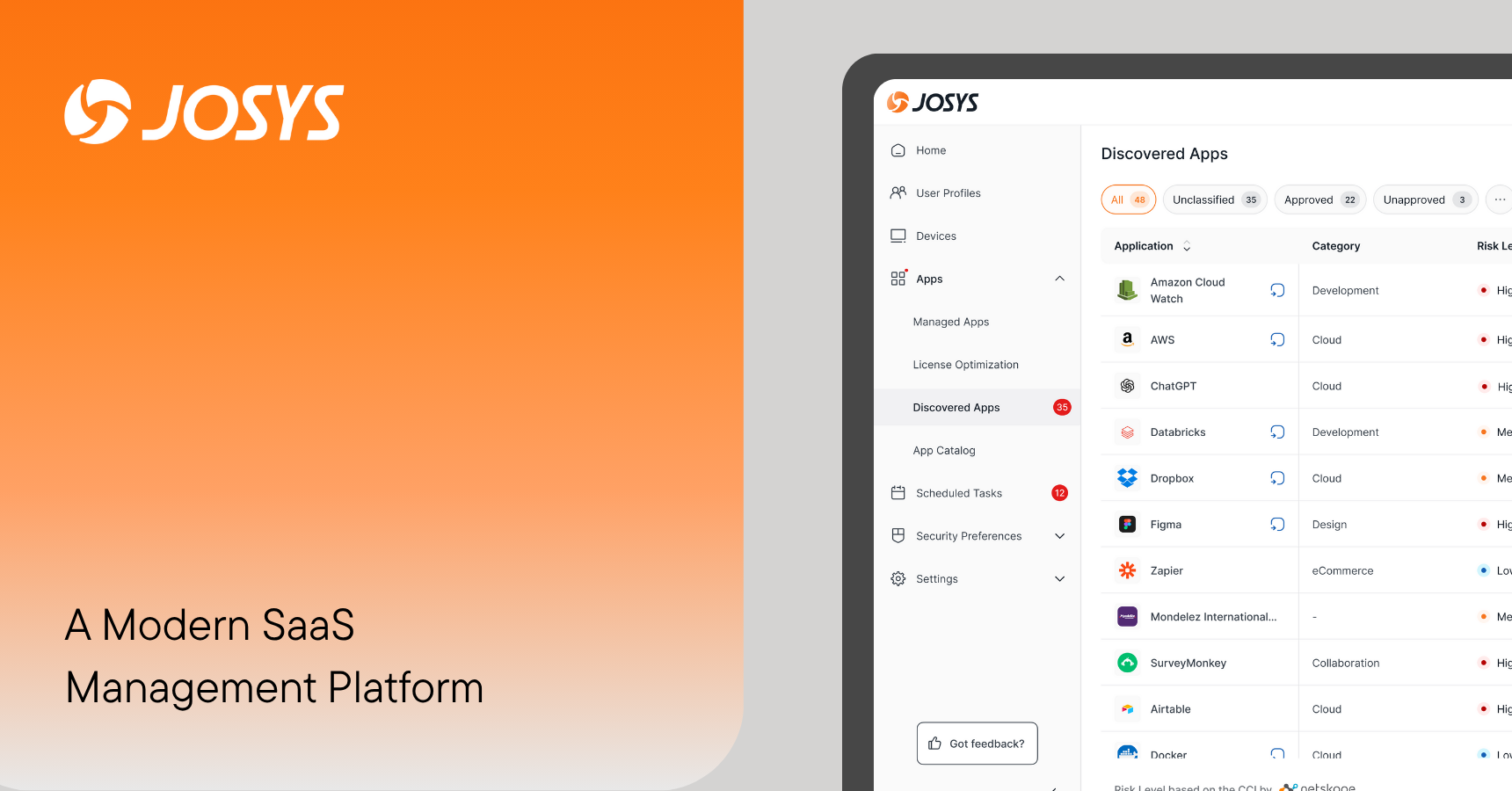
Josys: A Modern SaaS Management Platform
Josys functions as a centralized hub for managing SaaS applications across organizations. The platform automatically discovers shadow IT applications and offers visibility into user access patterns.
Integration with existing identity providers such as Azure AD, Okta, and Google Workspace enables seamless user provisioning and deprovisioning across all connected applications.
Core platform capabilities include:
Real-time SaaS application discovery
License optimization and cost tracking
Automated compliance reporting
Integration with 200+ SaaS applications
Josys maintains an up-to-date database of SaaS applications and their security profiles, allowing organizations to assess risk levels and implement appropriate access controls based on this intelligence.
What are the Key Identity-Centric Features Josys Offers?
The platform provides automated user lifecycle management across all connected SaaS applications. When employees join, leave, or change roles, Josys automatically updates their access permissions, ensuring a seamless transition throughout the employee lifecycle.
In addition, Josys tracks user activity across applications, helping organizations identify unused licenses or excessive permissions. The system also generates alerts when users access applications outside their normal usage patterns, allowing for timely intervention.
To support compliance requirements, the platform maintains detailed audit logs that capture all identity-related changes, access attempts, and administrative actions. These comprehensive logs make it easier to monitor and review system activity.
Josys: Use Case in Modern Identity Management
For example, a marketing team using 15 different SaaS tools can centralize access management through Josys. As a result, new team members receive appropriate application access within minutes instead of days, greatly improving onboarding efficiency.
Similarly, when employees depart, Josys automatically revokes their access across all connected applications. This process eliminates the risk of former employees retaining access to sensitive systems and strengthens overall security.
Common implementation scenarios:
Onboarding acceleration: New hires gain access to required tools in under 30 minutes
Offboarding security: Departing employees lose all access within 5 minutes
License optimization: Organizations typically reduce SaaS spending by 20-30%
When companies conduct compliance audits, Josys enables them to generate comprehensive access reports instantly. These reports clearly show which users have access to specific applications and when permissions were granted, simplifying the audit process.
Remote teams also benefit from streamlined access requests via Josys workflows. Managers can easily approve or deny access requests directly within the platform interface, enhancing both security and operational efficiency.
Conclusion
SaaS sprawl isn’t just a tech inconvenience—it’s a growing threat to operational clarity, security posture, and regulatory compliance.
As applications multiply across teams, the cracks in decentralized identity management become impossible to ignore. This guide has shown that the solution isn’t to restrict SaaS usage, but to bring order through intentional centralization.
Platforms like Josys don’t just plug gaps; they redefine how identity is managed—automating lifecycle changes, surfacing shadow IT, and enforcing access policies with precision. When identity data flows through a single, intelligent hub, IT regains control without slowing down the business. The ability to offboard an employee in minutes or generate an audit-ready access report instantly isn’t just a convenience—it’s a competitive advantage.
In today’s distributed environments, where every new app is a potential vulnerability, centralized identity management is the linchpin that transforms SaaS chaos into a secure, scalable ecosystem that supports innovation, not hinders it.
Ready to take control of your SaaS ecosystem? Request a personalized demo of Josys today and see how centralized identity management can streamline access, reduce risk, and simplify compliance across every app your teams use.