This site uses third-party website tracking technologies to provide and continually improve our services, and to display advertisements according to users' interests. I agree and may revoke or change my consent at any time with effect for the future.
Traditional identity management systems react to security threats after they occur, leaving organizations vulnerable to data breaches and compliance violations. Predictive access management uses artificial intelligence to identify and prevent SaaS identity risks before they materialize, transforming reactive security into proactive protection. Modern enterprises rely on dozens of cloud applications, creating complex access patterns that human administrators cannot effectively monitor.
Organizations implementing predictive access management report significant reductions in security incidents and improved compliance posture. The approach addresses the fundamental challenge of managing identities across multiple SaaS platforms while maintaining user productivity.
Key Takeaways
AI-driven predictive systems identify potential identity risks before they become security incidents
Modern SaaS environments require proactive access management due to their complexity and scale
Organizations achieve better security outcomes and compliance through predictive risk assessment
What is Predictive Access Management?
Predictive access management leverages artificial intelligence to forecast and prevent identity security breaches before they occur. This approach transforms traditional reactive security measures into proactive risk mitigation through continuous behavioral analysis and automated decision-making.
AI-Driven Approach that Anticipates and Mitigates Access Risks
Predictive access management uses machine learning algorithms to analyze user behavior patterns and system interactions across an organization's identity security infrastructure. The technology processes vast amounts of data from authentication logs, access permissions, and user activities to identify potential threats.
AI models examine historical access patterns to establish baseline behaviors for individual users and groups. These systems learn normal operational patterns for different roles, departments, and time periods.
The predictive engine generates risk scores for each access request based on multiple factors including user location, device fingerprinting, and requested resources. Organizations can configure automated responses ranging from additional authentication requirements to complete access denial.
Key prediction capabilities include:
User behavior deviation detection
Anomalous privilege escalation identification
Unusual access pattern recognition
Compromised credential detection
Predictive Access Management vs Traditional Identity & Access Management
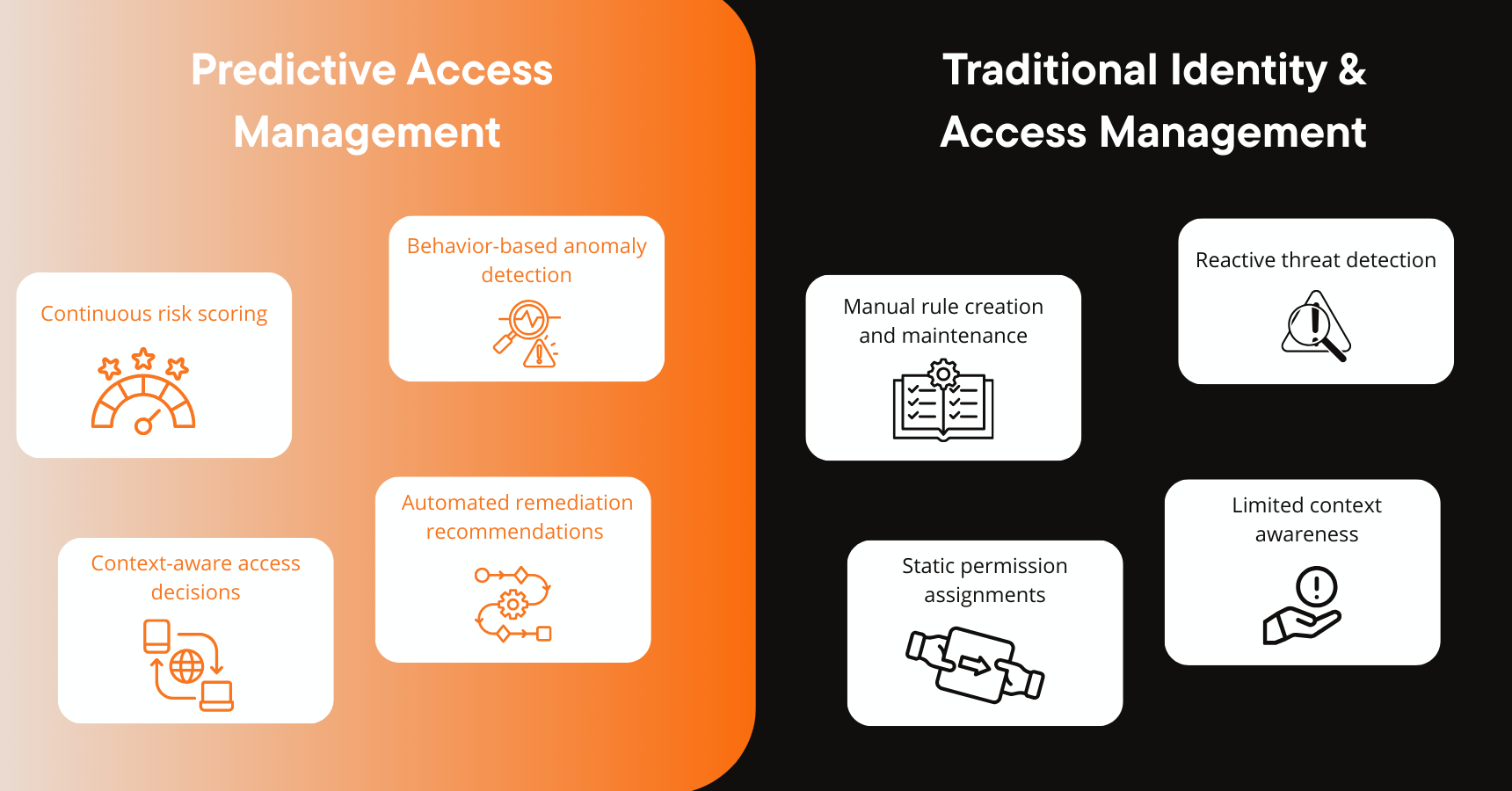
Traditional IAM systems rely on predefined rules and reactive monitoring to manage access controls. These legacy approaches typically respond to security incidents after they occur rather than preventing them.
Conventional identity and access management operates on static role-based permissions that remain unchanged until manual intervention. Users receive fixed access rights based on their job function or department affiliation.
Predictive access management introduces dynamic risk assessment that continuously evaluates each access request in real-time. The system adapts permissions based on current context rather than static assignments.
Traditional systems generate alerts after detecting suspicious activity. Predictive models intervene before unauthorized access occurs by analyzing behavioral patterns and environmental factors.
Traditional IAM limitations:
Manual rule creation and maintenance
Reactive threat detection
Static permission assignments
Limited context awareness
Core Capabilities of Predictive Access Management
Behavior-based anomaly detection analyzes individual user patterns to identify deviations from established norms. The system tracks login times, application usage, data access patterns, and geographic locations to create comprehensive behavioral profiles. Machine learning models detect subtle changes in user behavior that may indicate compromised credentials or insider threats. These algorithms identify anomalies such as unusual working hours, unfamiliar device usage, or atypical resource access attempts.
Continuous risk scoring assigns numerical values to each user session and access request based on multiple risk factors. Scores update in real-time as conditions change throughout user sessions.Risk calculations incorporate factors including user role, requested resources, access location, device security status, and historical behavior patterns. Higher-risk activities trigger additional verification steps or access restrictions.
Context-aware access decisions evaluate environmental factors surrounding each access request. The system considers time of day, user location, network security, device compliance status, and current threat intelligence. These decisions adapt to changing conditions without requiring manual rule updates. Context evaluation enables more precise access controls that balance security requirements with operational efficiency.
Automated remediation recommendations provide security teams with specific actions to address identified risks. The system suggests appropriate responses based on threat severity and organizational policies. Recommendations range from requiring additional authentication to temporarily suspending user accounts or adjusting privileged access management controls. These automated suggestions reduce response times and ensure consistent security enforcement.
How AI Powers Predictive Access Management
AI transforms traditional reactive security models by continuously analyzing user behavior patterns and SaaS interactions to predict and prevent identity-based threats before they materialize. Machine learning algorithms process vast datasets to identify anomalies, score risks, and trigger automated protective controls.
Data Ingestion from SaaS Usage Logs and HR Systems
Predictive access management systems collect data from multiple sources to build comprehensive user profiles. SaaS applications generate detailed logs capturing login attempts, file access patterns, API calls, and application usage metrics.
HR systems provide critical context through employee data including role changes, department transfers, termination dates, and reporting structures. This information helps AI models distinguish between legitimate access changes and potential threats.
Identity providers contribute authentication logs showing login locations, devices, and timing patterns. Network security tools add data about VPN usage, IP addresses, and connection anomalies.
Key data sources include:
Application access logs and session data
Authentication events and device information
HR records and organizational charts
Network traffic and location data
The system normalizes this diverse data into standardized formats for machine learning processing.
Pattern Recognition for Anomaly Detection
Machine learning algorithms analyze historical user behavior to establish baseline patterns for each identity. These models learn normal access times, typical applications used, standard file locations accessed, and regular collaboration patterns.
Behavioral analytics engines identify deviations from established patterns. An employee accessing sensitive files at unusual hours or downloading large datasets outside their normal workflow triggers anomaly flags.
The AI distinguishes between benign changes and potential threats. A user switching from Windows to Mac devices might be normal, but accessing competitor databases from a new location raises risk scores.
Common anomaly patterns detected:
Unusual login times or locations
Access to unfamiliar applications or data
Abnormal download volumes or file types
Changes in collaboration patterns
Advanced algorithms reduce false positives by incorporating contextual factors like business travel, project assignments, and seasonal work patterns.
Continuous Risk Scoring for Each Identity
AI models assign dynamic risk scores to every user identity based on real-time behavior analysis. These scores fluctuate continuously as new data arrives and user patterns evolve.
Risk calculations consider multiple factors simultaneously. Location changes, device switches, access pattern shifts, and privilege escalations all influence scoring algorithms.
Machine learning models weight different risk factors based on historical threat data and organizational policies. A finance employee accessing payroll systems receives different risk weighting than an intern performing similar actions.
Scores update in real-time, enabling immediate response to emerging threats.
Proactive Controls: Suspension, MFA Prompts, Role Adjustments
When risk scores exceed predefined thresholds, AI systems automatically trigger protective controls. These responses happen instantly without human intervention to prevent potential breaches.
Multi-factor authentication prompts activate for suspicious activities. Users accessing sensitive data from new devices face additional verification requirements before proceeding.
Account suspensions occur for high-risk scenarios. The system temporarily blocks access when detecting patterns consistent with compromised accounts or insider threats.
Automated control responses:
Step-up authentication for medium-risk activities
Session termination for policy violations
Access restrictions to sensitive resources
Role downgrades for departing employees
These controls balance security with user productivity by applying proportional responses to identified risk levels.
The Feedback Loop: Improving Models Over Time
Machine learning models continuously improve through feedback mechanisms that validate predictions against actual security outcomes. Security teams review flagged incidents to confirm true positives and identify false alarms.
This validation data trains algorithms to better distinguish between genuine threats and benign anomalies. Models learn from misclassifications to reduce false positives while maintaining high threat detection rates.
User feedback integration allows employees to report legitimate business reasons for flagged activities. The system incorporates this context to refine future predictions for similar scenarios.
Regular model retraining ensures algorithms adapt to evolving threat landscapes and changing business requirements. New attack patterns and organizational changes get incorporated into prediction models automatically.
Why AI-Native Identity Governance Platforms Like Josys are Critical Enablers
SaaS management platforms serve as the operational backbone for predictive access management by providing unified visibility across distributed application portfolios. They enable automated user provisioning workflows while delivering AI-powered insights that transform reactive security postures into proactive risk mitigation strategies.
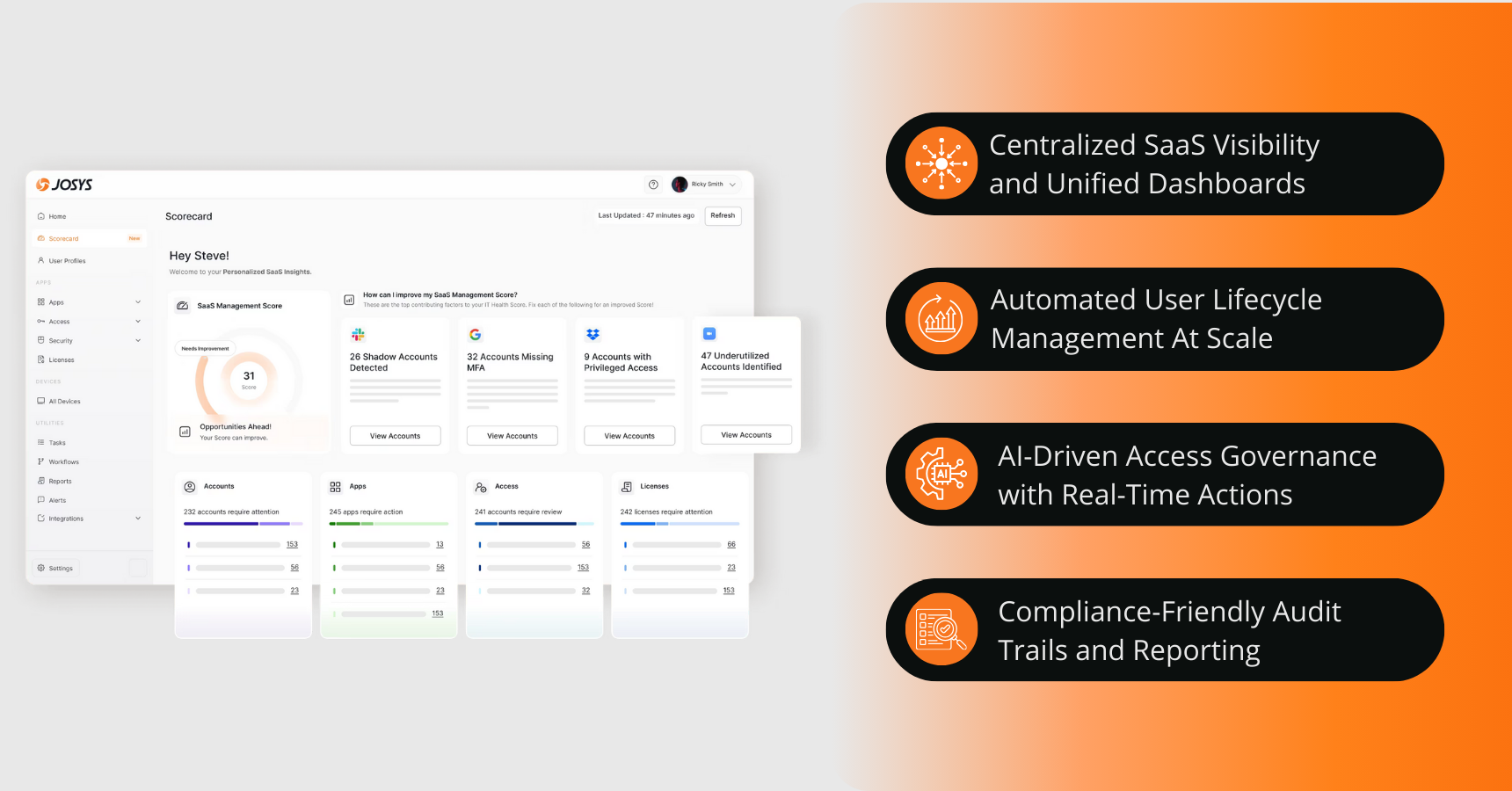
Centralized SaaS Visibility and Unified Dashboards
Organizations typically operate between 87 to 300+ SaaS applications across departments. Without centralized visibility, IT teams cannot identify shadow IT risks or monitor access patterns effectively.
SaaS management platforms aggregate application inventories into unified dashboards. They discover unauthorized applications through network monitoring and API integrations. This visibility enables security teams to map user access across their entire SaaS ecosystem.
Key visibility capabilities include:
Real-time application discovery and classification
User access mapping across multiple platforms
License utilization tracking and optimization
Risk scoring based on application sensitivity levels
The consolidated view eliminates blind spots that create identity governance gaps. Security teams can identify over-privileged users and dormant accounts that pose compliance risks.
Automated User Lifecycle Management At Scale
Manual user provisioning creates delays and security vulnerabilities. Organizations with 500+ employees cannot effectively manage access requests through email chains and spreadsheets.
SaaS management platforms automate user provisioning and de-provisioning workflows. They integrate with HR systems to trigger access changes based on role modifications or employee departures. This automation reduces the average de-provisioning time from weeks to hours.
Automated lifecycle features:
Role-based access provisioning templates
Scheduled access reviews and certifications
Automatic de-provisioning upon employment termination
Just-in-time access for temporary project needs
These workflows ensure regulatory compliance by maintaining accurate access records and reduce the risk of orphaned accounts that violate GDPR, HIPAA, and CCPA data protection requirements.
AI-Driven Access Governance with Real-Time Actions
Traditional access reviews occur quarterly or annually. This delayed approach cannot address rapidly evolving SaaS environments where access patterns change weekly.
AI-powered platforms analyze user behavior patterns to identify anomalous access requests. They flag privilege escalations that deviate from historical norms. Machine learning algorithms can predict which users will require specific access based on role transitions and project assignments.
Real-time governance capabilities:
Behavioral anomaly detection for access patterns
Predictive access recommendations based on peer analysis
Automated policy enforcement with exception handling
Risk-based authentication triggers for sensitive applications
The AI continuously learns from access decisions to refine future recommendations, creating adaptive security policies that evolve with organizational changes.
Compliance-Friendly Audit Trails and Reporting
Regulatory audits require detailed documentation of access decisions and user activities. GDPR Article 30 mandates processing records, while HIPAA requires access logs for protected health information.
SaaS management platforms maintain comprehensive audit trails across all connected applications. They generate automated compliance reports that map to specific regulatory requirements. These systems timestamp all access changes and maintain immutable logs.
Audit capabilities include:
Automated compliance reporting for GDPR, HIPAA, and CCPA
Access certification workflows with approval chains
Policy violation tracking and remediation records
User activity monitoring across integrated applications
The platforms reduce audit preparation time from months to days, providing auditors with standardized reports that demonstrate regulatory compliance across the entire SaaS portfolio.
Josys Differentiator: Seamless Integration, Built-In Analytics, Global Scalability
Josys distinguishes itself through pre-built integrations with 200+ SaaS applications and enterprise systems. The platform deploys without requiring extensive IT configuration or API development.
Their built-in analytics engine provides predictive insights without additional data science resources. Organizations can implement AI-driven access governance immediately rather than building custom analytics capabilities.
Josys advantages:
Native integrations with major SaaS providers and identity systems
Global deployment supporting multi-region compliance requirements
Real-time analytics dashboard with customizable risk metrics
Scalable architecture supporting 10,000+ users without performance degradation
The platform handles complex regulatory requirements across different jurisdictions, supporting multinational organizations managing diverse compliance obligations simultaneously.
Business Benefits of Predictive Access Management
Predictive access management delivers measurable returns through reduced security incidents, automated operations, optimized licensing costs, enhanced user productivity, and streamlined compliance processes. Organizations see immediate improvements in their security posture while reducing administrative overhead.
Reduced Breach Probability And Faster Incident Response
Predictive access management significantly lowers data breach risks by identifying potential security gaps before attackers exploit them. The system analyzes user behavior patterns to detect anomalous activities that could indicate insider threats or unauthorized access attempts.
Security teams receive automated alerts when the AI detects unusual privilege usage or access patterns. This early warning system enables faster incident response compared to traditional reactive security measures. The technology identifies potential privilege escalation attempts and lateral movement within networks before damage occurs.
Zero trust architecture principles become more effective when combined with predictive capabilities. The system continuously evaluates access decisions based on real-time risk assessments rather than static permissions. This approach strengthens overall security posture by ensuring least privilege access remains dynamically enforced.
Organizations typically see 40-60% fewer security incidents within the first year of implementation. Response times decrease from hours to minutes for critical access violations.
Lower Operational Burden Through Automation
Automated policy enforcement reduces manual oversight requirements for IT administrators. The system handles routine access reviews, permission adjustments, and compliance checks without human intervention. Security teams can focus on strategic initiatives rather than repetitive administrative tasks.
Predictive algorithms automate user provisioning and deprovisioning based on role changes and employment status. The technology eliminates delays in access modifications that traditionally require manual approval processes. Access requests get processed faster while maintaining security standards.
Explainability features help administrators understand why specific access decisions were made. This transparency reduces the time spent investigating access-related issues and builds confidence in automated systems. Teams spend 50-70% less time on access management tasks.
Cost Savings From Unused Licenses And Optimized Roles
License optimization generates immediate cost reductions by identifying unused or underutilized SaaS subscriptions. The system tracks actual usage patterns rather than relying on self-reported data or periodic audits. Organizations typically recover 20-35% of their SaaS spending through license rightsizing.
Role-based access gets optimized automatically based on actual job functions rather than requested permissions. Many employees receive excessive privileges that remain unused throughout their tenure. Predictive analysis identifies these over-provisioned accounts and suggests appropriate adjustments.
Automated compliance reporting reduces audit preparation costs. The system maintains continuous documentation of access decisions and policy enforcement actions. External audit fees decrease when organizations can provide comprehensive access histories and justifications.
Improved Employee Experience With Secure, Frictionless Access
Employees gain faster access to necessary applications while security remains robust. Predictive systems approve legitimate access requests instantly based on behavioral patterns and contextual factors. Wait times for application access drop from hours or days to seconds.
Zero trust principles don't compromise user experience when implemented predictively. The system learns normal user behaviors and reduces authentication friction for routine activities. Users only face additional security challenges when their behavior deviates from established patterns.
Self-service capabilities expand safely through intelligent automation. Employees can request access to new applications with confidence that approvals will be processed quickly and accurately. The system reduces false positives that historically frustrated users with unnecessary security challenges.
Productivity increases when employees spend less time navigating access barriers. Studies show 15-25% improvement in task completion rates when access friction decreases without compromising security standards.
Stronger Compliance Posture Without Extra Overhead
Continuous monitoring ensures ongoing compliance rather than periodic snapshot assessments. The system documents every access decision with timestamps, justifications, and risk assessments. Audit trails become comprehensive and readily available for regulatory reviews.
Automated policy updates keep access controls current with changing regulations. The system adapts to new compliance requirements without manual reconfiguration of existing access policies. Organizations maintain compliance across multiple frameworks simultaneously.
Explainability features satisfy auditor requirements for understanding access control decisions. Regulators can trace the logic behind specific permissions and verify that appropriate controls exist. This transparency reduces audit duration and associated costs.
Real-time compliance reporting replaces manual preparation efforts. The system generates required documentation automatically and maintains current compliance status dashboards. Organizations avoid compliance violations through proactive monitoring rather than reactive corrections.
Conclusion
Organizations face mounting pressure to secure their SaaS environments before threats materialize. Traditional reactive approaches leave critical gaps that modern threat actors exploit daily.
Predictive Access Management represents a fundamental transformation in security strategy. AI-driven platforms analyze patterns, detect anomalies, and prevent identity risks before they cause damage.
Josys delivers comprehensive AI-powered identity governance that transforms how organizations manage SaaS access. The platform combines predictive analytics with automated risk mitigation to create robust security frameworks.
Early adopters gain substantial competitive advantages through enhanced security posture and operational efficiency. They position themselves ahead of organizations still relying on manual, reactive processes.
Ready to transform your identity governance strategy? Book a demo with Josys to see how AI-powered predictive access management can secure your SaaS environment while improving operational efficiency.