This site uses third-party website tracking technologies to provide and continually improve our services, and to display advertisements according to users' interests. I agree and may revoke or change my consent at any time with effect for the future.
Understanding the Cybersecurity Maturity Model Certification
If your organization works with the Department of Defense (DoD), you've likely encountered the acronym CMMC, and the mounting pressure to understand what it means for your business. The Cybersecurity Maturity Model Certification isn't just another compliance checkbox. It's a fundamental shift in how the DoD protects sensitive information across its vast supply chain.
For government contractors, CMMC compliance is quickly becoming non-negotiable. Without the appropriate certification level, you won't be eligible to bid on or renew DoD contracts. This reality has sent IT directors scrambling to assess their current security posture, identify gaps, and develop actionable roadmaps to meet these new requirements.
In this guide, we'll break down what CMMC is, who needs to comply, how the certification levels work, and what practical steps you can take to prepare your organization. Whether you're new to CMMC or navigating the recent 2.0 updates, you'll walk away with clarity on what matters most.
What is CMMC?
The Meaning and Purpose of CMMC for Government Contractors
The Cybersecurity Maturity Model Certification (CMMC) is a unified standard for implementing cybersecurity across the Defense Industrial Base (DIB). It was designed to verify that contractors handling sensitive federal information have adequate security controls in place: not just on paper, but in practice.
CMMC combines various cybersecurity standards and best practices into a single, comprehensive framework. It incorporates requirements from NIST SP 800-171, NIST SP 800-172, and other federal guidelines, then adds a verification component through third-party assessments. The goal is straightforward: ensure that Controlled Unclassified Information (CUI) and Federal Contract Information (FCI) remain protected throughout the entire supply chain.
Unlike previous self-attestation models, CMMC requires independent validation. This means contractors must demonstrate their security maturity to certified assessors before they can compete for DoD contracts.
Why the Department of Defense Introduced the CMMC Framework
The DoD didn't create CMMC arbitrarily. Over the past decade, cyber threats targeting defense contractors have escalated dramatically, with a 300% increase in cyber attacks since 2018. Nation-state actors and sophisticated threat groups have successfully infiltrated contractor networks, stealing intellectual property, weapons designs, and sensitive operational data.
The previous compliance model, where contractors self-certified their adherence to NIST 800-171, proved insufficient. Studies found companies implemented only 39% of NIST 800-171 controls, creating vulnerabilities that adversaries readily exploited. The DoD needed a way to verify security practices across thousands of contractors, from prime contractors to small subcontractors several tiers down the supply chain.
CMMC addresses this problem by establishing standardized maturity levels and requiring third-party assessments. It shifts the burden of proof from self-reporting to independent verification, creating accountability and raising the baseline security posture across the entire defense ecosystem.
Who Needs to Comply with CMMC?
Types of Organizations Required to Meet CMMC Standards
CMMC applies to any organization that participates in the Defense Industrial Base. This includes:
Prime contractors who hold direct contracts with the DoD
Subcontractors at all tiers who handle FCI or CUI as part of their work
Suppliers and vendors who provide products or services that involve access to sensitive information
Managed service providers who support contractor IT environments containing covered information
The scope extends beyond traditional defense manufacturers. If you're a software developer, engineering firm, consulting company, or technology provider working on DoD projects, CMMC likely applies to you. Even organizations that only occasionally handle sensitive data must meet the appropriate certification level.
Key Implications for Federal and Defense Contractors in the United States
For contractors, CMMC compliance isn't optional, it's a contractual requirement. The DoD has made it clear that CMMC certification will be a prerequisite for contract awards, affecting approximately 337,968 Defense Industrial Base contractors. If you can't demonstrate the required maturity level, you won't be eligible to bid, regardless of your technical capabilities or pricing.
This creates significant business implications. Organizations that fail to achieve certification risk losing existing contracts when they come up for renewal. Companies planning to expand their DoD work must factor in the time and investment required to reach compliance. For many IT directors, this means reprioritizing security initiatives, allocating budget for assessments, and potentially restructuring IT operations to meet CMMC standards.
The ripple effects extend through the supply chain. Prime contractors are increasingly requiring their subcontractors to demonstrate CMMC readiness, even before it's formally mandated in contracts. This creates pressure throughout the ecosystem to accelerate compliance efforts.
How Does CMMC Work? The Structure of Certification Levels
Overview of the Five CMMC Certification Levels
The original CMMC framework defined five maturity levels, each building on the previous one. While CMMC 2.0 has streamlined this structure (which we'll discuss shortly), understanding the original levels provides important context:
Level 1 (Basic Cyber Hygiene): Foundational practices to protect Federal Contract Information
Level 3 (Good Cyber Hygiene): Managed and reviewed processes with additional protections for CUI
Level 4 (Proactive): Advanced practices to detect and respond to evolving threats
Level 5 (Advanced/Progressive): Optimized processes to protect against advanced persistent threats
Each level required progressively more sophisticated security controls, documentation, and organizational maturity. The certification level required for a specific contract depends on the sensitivity of the information involved and the nature of the work being performed.
Core Requirements at Each Maturity Level
The requirements at each level encompass multiple domains, including access control, incident response, system and communications protection, and personnel security. At Level 1, organizations implement basic safeguards like antivirus software and user access controls. By Level 3, contractors must have comprehensive security programs including regular vulnerability scanning, security awareness training, and incident response capabilities.
Higher levels introduce advanced capabilities like threat hunting, continuous monitoring, and sophisticated defense mechanisms. The key distinction isn't just the number of controls, but the organizational maturity in implementing and maintaining them. Documentation, process consistency, and continuous improvement become increasingly important at higher levels.
Key Updates in CMMC 2.0 and Current Developments
Major Changes Introduced in CMMC 2.0
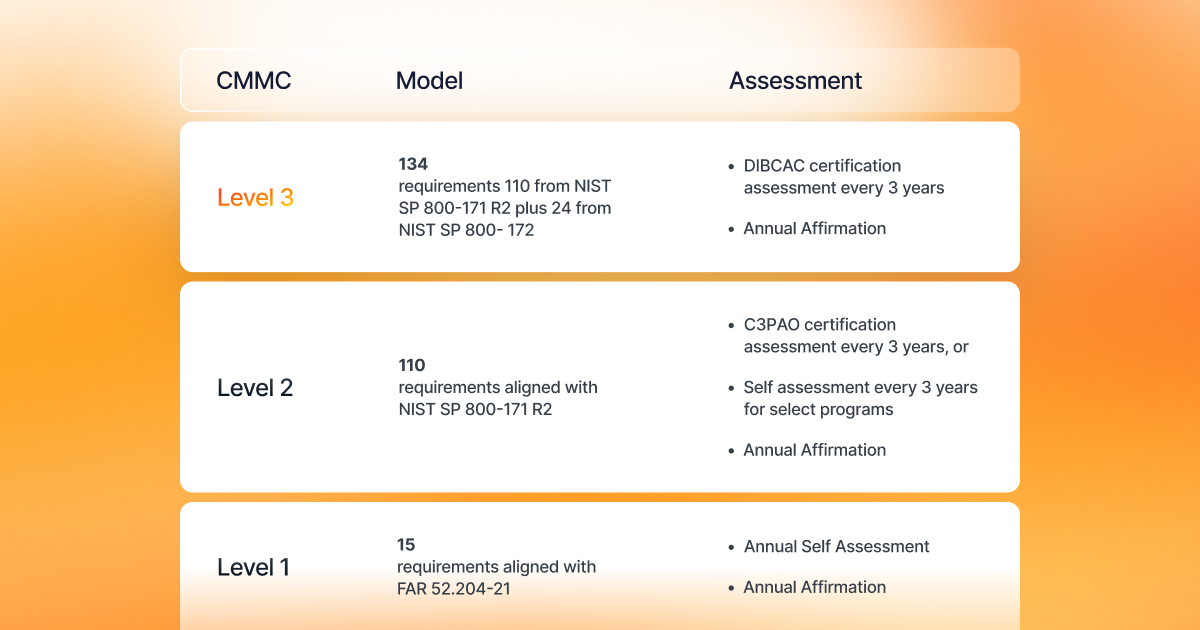
In November 2021, the DoD announced CMMC 2.0, a streamlined version that addresses feedback from industry stakeholders. The most significant changes include:
Reduced to three levels: Level 1 (Foundational), Level 2 (Advanced), and Level 3 (Expert)
Alignment with existing regulations: Level 2 directly maps to NIST SP 800-171 requirements
Self-assessment options: Some Level 2 contractors can self-assess rather than undergo third-party certification
Tiered assessment approach: Not all contracts require full third-party assessments
Annual affirmations: Certified organizations must affirm their continued compliance annually
These changes aim to reduce compliance burden while maintaining security effectiveness. The streamlined structure makes it easier for contractors to understand their requirements and plan their compliance journey. However, the core security standards remain rigorous. CMMC 2.0 isn't about lowering the bar, but making the path to compliance more practical.
What Contractors Should Know About Ongoing CMMC Revisions
CMMC continues to evolve as the DoD refines its implementation approach. The rulemaking process has involved extensive public comment periods, with the DoD considering feedback from contractors, industry associations, and cybersecurity experts. As of now, the final rule is working its way through federal approval processes.
Contractors should stay informed about several key areas: the timeline for mandatory inclusion in contracts, the specific assessment requirements for different contract types, and the criteria for determining which level applies to their work. The DoD has committed to a phased rollout, giving contractors time to prepare, but waiting until requirements are finalized could leave you scrambling.
Our recommendation? Start your compliance journey now. The core security practices required by CMMC represent sound cybersecurity hygiene regardless of regulatory mandates. Organizations that proactively address gaps will be better positioned to compete for contracts and protect their own sensitive information.
Navigating CMMC Compliance: Practical Steps for Government Contractors
Preparation Strategies and Readiness Assessments
Beginning your CMMC compliance journey starts with understanding where you stand today. Conduct a gap assessment comparing your current security controls against the requirements for your target CMMC level. This assessment should cover technical controls, documentation, and organizational processes.
Here's a practical roadmap to get started:
Identify your required CMMC level: Review your existing contracts and pipeline to determine which level you'll need
Inventory your systems and data: Map where CUI and FCI exist in your environment
Conduct a self-assessment: Evaluate your current controls against CMMC requirements
Prioritize gaps: Focus on high-risk areas and controls with the longest implementation timelines
Develop a remediation plan: Create a realistic timeline with milestones and resource requirements
Implement and document: Execute your plan while maintaining detailed documentation of your security practices
Schedule your assessment: Engage with a C3PAO when you're ready for formal certification
From our experience helping IT directors manage complex compliance requirements, the documentation component often takes longer than expected. You may already have security controls in place, but if they're not properly documented with policies, procedures, and evidence of implementation, they won't count during your assessment. As we've seen with SaaS management challenges, maintaining visibility and documentation across distributed systems requires dedicated tools and processes, not just good intentions.
Working with Certified Third-Party Assessment Organizations (C3PAOs)
For most contractors, achieving CMMC certification requires working with a Certified Third-Party Assessment Organization (C3PAO). These independent assessors evaluate your security controls and determine whether you meet the requirements for your target level.
Choosing the right C3PAO matters. Look for organizations with experience in your industry, clear communication practices, and a collaborative approach. The assessment process shouldn't feel adversarial, the best C3PAOs act as partners who help you understand requirements and identify opportunities for improvement.
Before engaging a C3PAO for formal assessment, consider a pre-assessment or readiness review. This informal evaluation identifies gaps you can address before the official certification process begins, saving time and reducing the risk of failing your formal assessment. Think of it as a practice run that helps you enter the real assessment with confidence.
The assessment itself involves reviewing documentation, interviewing personnel, and testing controls. Assessors will want to see evidence that your security practices are actually implemented, not just written in policies. This means demonstrating logs, showing configuration settings, and walking through how you handle security incidents in practice.
A Fundamental Shift in Cybersecurity
CMMC represents a fundamental shift in how the Department of Defense approaches cybersecurity across its contractor ecosystem. For government contractors, understanding and achieving CMMC compliance isn't just about meeting regulatory requirements; it's about protecting sensitive information, maintaining competitive eligibility, and demonstrating your commitment to security excellence.
The path to compliance requires careful planning, dedicated resources, and often significant changes to your IT operations. But contractors who approach CMMC strategically, starting early and building security into their organizational DNA, will find themselves better positioned not just for DoD contracts, but for the broader cybersecurity challenges facing all organizations today.
Simplify CMMC with Josys
Ready to streamline your path to CMMC compliance? Josys provides centralized visibility and control across your SaaS applications, endpoints, and IT infrastructure - addressing multiple CMMC requirements simultaneously. Our platform automates evidence collection, enforces access controls, and maintains the audit trails assessors require. Book a demo to see how Josys can transform your CMMC preparation from a compliance burden into a competitive advantage.
Frequently Asked Questions
How Does Josys Help Businesses Fulfill CMMC?
The Josys autonomous identity governance platform makes a part of the complex, 110-requirement process manageable and sustainable. Josys operationally simplifies some of the painful aspects of compliance, securing your digital perimeter through automated access controls, audit tracking, and configuration management.
How Does CMMC Differ from NIST and Other Cybersecurity Standards?
CMMC incorporates NIST standards, specifically NIST SP 800-171 and 800-172, but adds a critical verification component. While NIST provides the technical requirements, CMMC creates a certification framework with defined maturity levels and mandatory third-party assessments. The key difference is enforcement: NIST 800-171 previously relied on self-attestation, whereas CMMC requires independent validation by certified assessors. CMMC also integrates practices from multiple frameworks into a single, unified model specifically designed for the Defense Industrial Base. Think of NIST as the technical foundation and CMMC as the certification structure built on top of it.
How Does CMMC Help Protect Controlled Unclassified Information (CUI)?
CMMC protects CUI by ensuring that contractors implement appropriate security controls throughout the information lifecycle, from creation and storage to transmission and destruction. The framework requires both technical safeguards (like encryption and access controls) and organizational practices (like security awareness training and incident response procedures). By mandating third-party assessments, CMMC verifies that these protections are actually in place and functioning effectively. This creates a more secure supply chain where CUI remains protected even as it moves between prime contractors, subcontractors, and vendors. The maturity level approach also ensures that organizations handling more sensitive information implement more sophisticated protections.
Where Can I Find Official Guidance or CMMC Resources?
The primary source for official CMMC information is the CMMC Accreditation Body (CMMC-AB) website and the Office of the Under Secretary of Defense for Acquisition & Sustainment (OUSD(A&S)). These sites provide the official CMMC model documents, assessment guides, and updates on rulemaking progress. The NIST website offers the underlying technical standards (SP 800-171 and 800-172) that inform CMMC requirements. Additionally, the Defense Counterintelligence and Security Agency (DCSA) provides resources related to protecting CUI. For practical guidance, consider joining industry associations like the National Defense Industrial Association (NDIA), which offers CMMC working groups and educational resources. Always verify that you're consulting current, official sources, as CMMC continues to evolve through the rulemaking process.