This site uses third-party website tracking technologies to provide and continually improve our services, and to display advertisements according to users' interests. I agree and may revoke or change my consent at any time with effect for the future.
Governance without context is just compliance theater. You can build policy frameworks, assign data owners, and tick audit checkboxes, but if your AI systems operate without situational awareness baked into the controls, you're producing paperwork, not protection. AI contextual governance changes that equation: it ties every control, every access decision, and every risk threshold directly to the business context in which an AI system actually operates.
What Is AI Contextual Governance?
AI contextual governance applies dynamic, situation-aware controls to AI systems based on real-time organizational signals: who is accessing what, from which device, for what business purpose, under which regulatory regime, and at what risk tier. Static policy sets a rule once. Contextual governance evaluates both the rule and the environment every time.
Consider this: a fraud-detection AI tool running in a retail banking context carries different risk obligations than the same model architecture deployed in an HR system to score job applicants. Identical technology; entirely different governance requirements. Contextual governance encodes that difference into the control layer itself, rather than leaving it to manual review.
Why Traditional Governance Leaves Leaders Flying Blind
Traditional AI governance stalls at the compliance layer. It documents models, assigns owners, and produces static risk assessments, then updates them annually, if you're diligent. The problem: AI systems retrain continuously, access patterns shift weekly, and shadow AI tools proliferate faster than any annual review cycle can catch.
Strategic visibility requires something harder to build: a live signal from every AI system into a unified view that executives, IT, and risk teams can act on without translation. When that signal is absent, a predictable pattern emerges. IT teams manage AI access through the same spreadsheets they used for SaaS licenses five years ago, with the same blind spots and the same lag time.
THECOO, a professional services firm, discovered exactly this failure mode: unmanaged accounts, shadow application usage across departments, and no single vantage point from which to assess exposure. Visibility wasn't a reporting problem. It was a structural one.
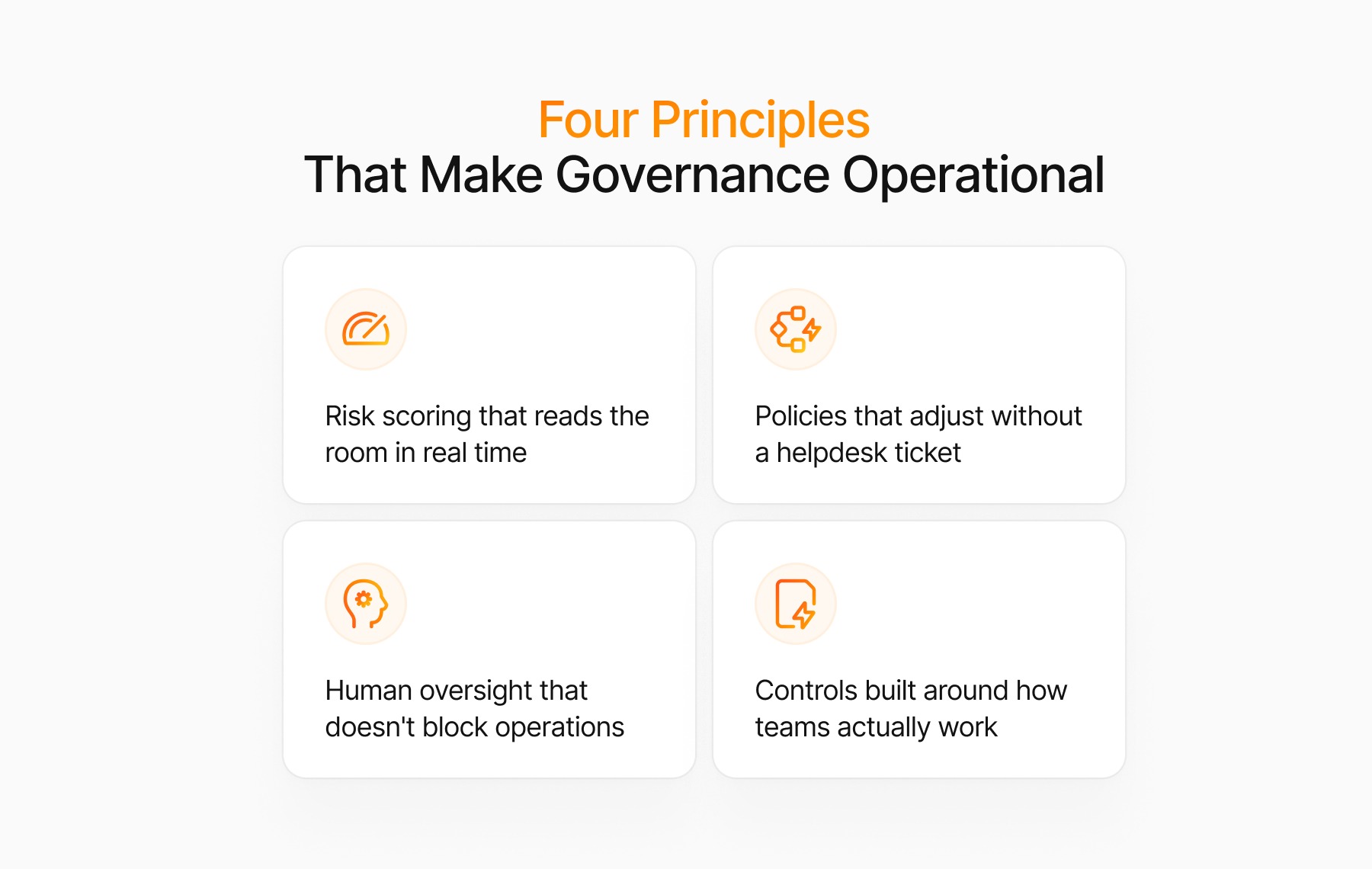
Four Principles That Make Governance Operational
1. Risk scoring that reads the room
Risk scoring needs to ingest actual context: user role, device state, and regulatory jurisdiction. A model interaction that was low-risk at 9 AM on a managed corporate device becomes high-risk at 11 PM on an unmanaged personal endpoint. Static scores miss that delta entirely.
Effective contextual risk scoring pulls at a minimum four signals: identity tier, device compliance state, data sensitivity of the prompt or output, and the business process the AI is embedded in. These inputs convert a single binary risk label into a dynamic posture that reflects operational reality.
2. Policies that adjust without a helpdesk ticket
Adaptive policies adjust access and output permissions automatically as context shifts. A user querying a summarization model for internal briefings receives a single permission set. The same user querying a model with access to customer PII gets a tighter one, enforced at machine speed, not human speed. The mechanism is policy-as-code: rules defined programmatically so they run before any manual override is even requested.
3. Human oversight that doesn't block operations
Human-in-the-loop oversight halts automation for review. Human-on-the-loop oversight is different: humans monitor, set thresholds, and intervene when anomalies surface, but don't interrupt routine operations. For most enterprise AI deployments, on-the-loop is the right posture. It preserves operational velocity while ensuring accountability for edge cases that automated systems flag but can't resolve.
4. Controls built around how teams actually work
Governance frameworks that ignore organizational culture erode on contact with reality. A policy requiring AI output review before external publication works in a law firm with structured approval workflows. It creates bottlenecks in a product team shipping daily releases. Build controls that fit the actual decision velocity of each business unit.
Ethical alignment (ensuring AI outputs don't amplify bias or misrepresent data) requires embedding validation checkpoints at the model output layer, not after the fact in a compliance report.
The Four Visibility Dimensions Leaders Need
Technical visibility
Technical visibility covers model inventory, version tracking, API dependency mapping, and infrastructure posture. You need to know which models are deployed, which versions are active, which endpoints they expose, and which datasets they were trained on. Without this layer, drift detection and incident response are guesswork.
Access and operation visibility
Operational visibility tracks who uses AI tools and how they use them. Sales Marker, an IT software company, faced a stark version of this problem. IT teams couldn't determine who was using which application, creating inefficiency and security exposure simultaneously. Once they centralized visibility, IT management time dropped by more than 50%. Access visibility converts usage into actionable insight.
Compliance visibility
Compliance visibility confirms that every AI system in production satisfies the regulatory obligations applicable to its use case: GDPR data residency, SOC 2 access logging, and sector-specific AI regulations. This layer must be queryable on demand, not assembled manually before an audit.
Business ROI visibility
ROI visibility quantifies what AI investments actually return: time reclaimed, decisions accelerated, costs avoided. Tsukulink, a construction technology firm, recovered four to six hours of overtime per week after centralizing IT and SaaS operations, a direct, measurable productivity return. Contextual governance must produce the same class of evidence for AI systems, or it will lose budget battles to teams that can show their numbers.
The Implementation Roadmap
Step 1: Inventory and map AI systems
Start with a complete AI system inventory: every AI in production, every API integration, every third-party AI feature embedded in SaaS tools. Most organizations undercount by 30 to 50% on the first pass because AI capabilities are bundled inside existing software licenses. Map data flows, not just deployments.
Step 2: Classify by context and risk
Classify each AI system against three axes: data sensitivity (public, internal, confidential, regulated), business criticality (experimental, operational, mission-critical), and regulatory exposure (general, sector-specific, cross-border). This classification drives control selection. You don't apply the same governance rigor to an internal chatbot as to a credit decisioning model.
Step 3: Instrument real-time monitoring and explainability
Instrument every production model with telemetry that captures inputs, outputs, latency, confidence scores, and user identity. Explainability (the capacity of a system to produce human-readable justifications for its outputs) is non-negotiable for high-stakes use cases. Without it, compliance and legal teams cannot defend decisions made with AI assistance.
Step 4: Embed adaptive controls and zero trust
Zero trust (the security principle that no user or device is trusted by default, regardless of network location) applies directly to AI governance. Every interaction with a model gets authenticated, authorized, and logged. Embed adaptive controls at the API gateway layer so that context-based policy enforcement executes before any model query is processed.
Step 5: Build dashboards people actually use
Dashboards fail when they're built for IT teams and then presented to executives. Instrument governance outputs at two levels: operational dashboards for IT and risk teams, and a strategic summary for leadership that surfaces five to seven metrics, including model risk posture, compliance status, cost variance, shadow AI detections, and ROI delta. Monthly reviews institutionalize accountability. Quarterly reviews don't.
Six KPIs the Board Will Actually Read
Boards read numbers that connect to outcomes they own. Build your governance dashboard around these six:
AI risk exposure score: aggregate risk rating across all deployed AIs, updated weekly
Shadow AI detection rate: number of unauthorized AI tools identified in the last 30 days
Compliance coverage percentage: share of AI systems fully instrumented against applicable regulations
Model drift incidents: count of models flagged for behavioral deviation from baseline
License cost variance: the delta between contracted AI spend and actual consumption
Governance ROI: quantified time and cost savings attributable to automated controls
These six metrics give a board member a complete picture in under three minutes. Anything more detailed belongs in the operational layer.
Continuous Improvement: Where Most Programs Fall Short
Model drift alerts
Model drift (the gradual degradation of a model's predictive accuracy as real-world data diverges from training data) is the silent failure mode in AI governance. Research indicates 91% of ML models degrade over time in production. Configure automated drift alerts that trigger when a model's output distribution shifts beyond a defined threshold, typically two standard deviations from the 30-day baseline. Alert routing goes to both the model owner and the risk team simultaneously.
License and cost optimization
AI license sprawl mirrors SaaS sprawl. Unused model API seats, redundant AI features across overlapping tools, and shadow AI subscriptions purchased with corporate cards erode budget without a governance layer to catch them. IBM's 2025 Cost of a Data Breach Report found that organizations with high shadow AI usage faced $670,000 in additional breach costs. Automate license reconciliation monthly: compare provisioned access against actual usage, and flag any seats unused for 30-plus days for review.
Automated privilege review
Automated privilege review revokes or downscales AI access permissions for users whose roles have changed, who have left the organization, or whose usage patterns indicate dormancy. THECOO's pre-governance environment had exactly this gap. Former employee accounts persisted long after offboarding, creating cost waste and security exposure. Automate the review cycle to run at 30-, 60-, and 90-day intervals, with no manual trigger required.
Why the Platform Layer Matters
Contextual governance breaks down when identity, SaaS management, and AI oversight run in separate silos. According to Gartner, organizations deploying AI governance platforms are 3.4 times more likely to achieve high governance effectiveness.
The platform requirement is specific: ingest signals from all three layers (user identity state, SaaS license and access data, AI system telemetry) and surface them in a unified control plane. When a user is offboarded, their AI tool access, SaaS licenses, and device assignments should close in a single workflow, with no manual reconciliation across three systems. Josys connects identity lifecycle management with SaaS and device visibility, giving IT teams the single-pane view that makes contextual governance operationally executable rather than aspirationally documented.
From Compliance Documentation to Operational Control
AI contextual governance closes the gap between compliance documentation and operational control. It equips your AI environment with real-time risk scoring, adaptive access policies, and executive-grade visibility, so every stakeholder, from IT to the boardroom, reads from the same signal.
The organizations that implement it stop reacting to AI risk and start managing it with the same rigor they apply to financial controls.
Josys gives IT and risk teams a unified view of identity, SaaS, and AI governance. No stitched-together spreadsheets, no blind spots. Request a demo here.
FAQs
How do I integrate contextual governance with an existing IGA or SaaS management stack?
Start with your identity governance and administration (IGA) system as the authoritative source for user context: roles, departments, access tiers, and employment status. Map AI system access rights to the same identity attributes your IGA already manages. Build the integration surface incrementally: identity first, then SaaS license linkage, then AI telemetry ingestion.
Which metrics prove cost savings from strategic visibility?
Three metrics carry the most weight in budget conversations: license costs recovered from deprovisioning unused AI seats (measured monthly), IT labor hours reclaimed through automated access reviews (benchmarked against your pre-automation baseline), and incident response time reductions for AI-related security events. Sales Marker's 50%-plus reduction in IT management time is the class of evidence you're building toward, a before/after comparison tied to a specific operational change, not an estimate.