This site uses third-party website tracking technologies to provide and continually improve our services, and to display advertisements according to users' interests. I agree and may revoke or change my consent at any time with effect for the future.
At most growing companies, an ex-employee retains active access to at least one critical system for weeks after their last day. A contractor keeps admin privileges long after their project ends. A marketing manager still has elevated permissions in your analytics platform two years after the campaign that required them. And increasingly, someone in finance is quietly pasting quarterly performance data into a public AI tool to draft a summary.
These are not edge cases. They are the day-to-day reality for organizations that have not implemented periodic access reviews, a structured process for examining who has access to what and whether that access still makes sense.
The scale of the problem has grown sharply in the last 18 months, as Josys's Shadow AI research shows in detail below. These are the same access governance failures that have always plagued SaaS, now compounded by a new and faster-moving category of tools.
Without regular reviews, your access picture becomes opaque. Opacity is where breaches start.
This article breaks down why periodic access reviews matter, how to structure them efficiently, what Shadow AI changes about the equation, and what happens when organizations skip the practice. It also covers practical frameworks you can put to work today, whether you are starting from scratch or refining an existing process.
The Role of Periodic Access Reviews in Modern Organizations
Periodic access reviews are the structured checkpoints that keep access rights aligned with actual business needs, rather than historical permissions that accumulate over time. For a deeper look at the fundamentals, see what a user-access review entails.
Strengthening Security Posture with Regular Assessments
Every access grant represents a potential attack vector. Regular reviews force a single useful question: if a threat actor compromised this account today, what damage could they do? That question becomes more urgent as your SaaS and AI tool stack expands.
Take a common scenario. A marketing manager needs admin access to your analytics platform for one campaign. The campaign ends. Two years later, the access still exists, the manager has moved to a new role, and responsibilities have shifted. The permissions never followed the person.
This is permission accumulation, often called privilege creep, and it is one of the most common vulnerabilities in mid-sized SaaS estates. Regular assessments catch it before it becomes an incident. You are not just removing access, you are actively shrinking the attack surface every cycle.
Meeting Compliance and Regulatory Demands
Compliance frameworks do not suggest periodic access reviews. They require them. SOC 2, ISO 27001, GDPR, HIPAA, and most major compliance frameworks include provisions for regular access certification. The newer wave of AI-specific regulation is piling on, with 47 percent of organizations citing AI model transparency rules and Privacy Act amendments as their greatest compliance hurdle.
The point many organizations miss: compliance is not about checking a box during audit season. It is about building a defensible process that proves you know who has access to sensitive data and why, including data flowing into AI tools. When auditors ask for access review records, what they are really asking is whether you can demonstrate control. Periodic reviews produce the evidence trail that answers that question.
Supporting Audits and Maintaining Accountability
Audits reveal whether access controls exist in theory or in practice. Many organizations have well-written policies that fall apart under audit scrutiny because nobody actually reviews access on a regular cadence. Learn more about what a compliance audit entails.
Periodic reviews create accountability loops. When managers must certify that their team members' access is appropriate, they become active participants in security rather than passive bystanders. This distributed model scales far better than asking IT to track every permission across every system manually.
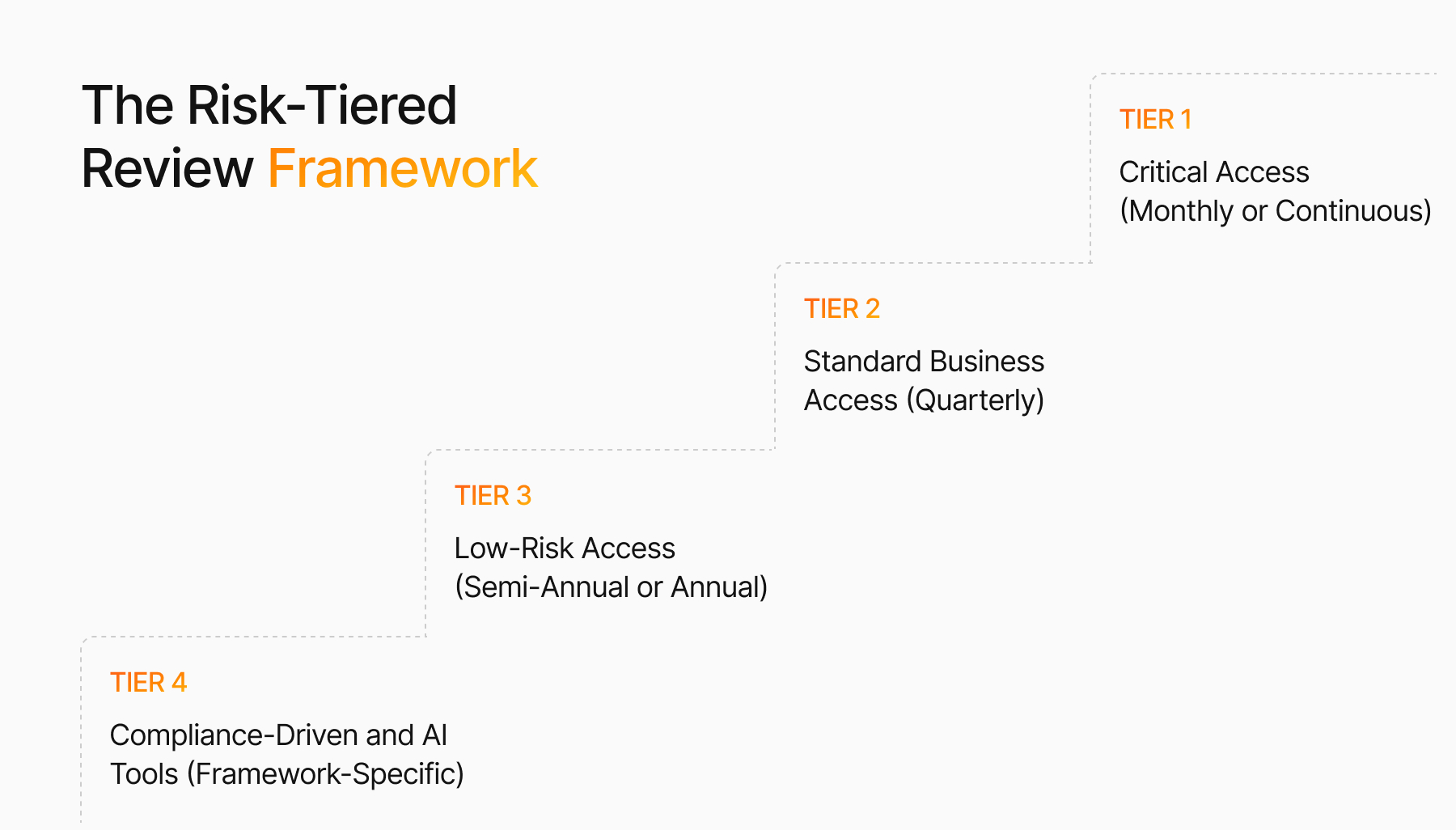
The Risk-Tiered Review Framework
Not all access requires the same scrutiny. A risk-tiered approach focuses on intensive oversight where it matters most and on lighter-touch review for lower-risk systems.
Tier 1: Critical Access (Monthly or Continuous)
Tier 1 covers your most sensitive systems: financial platforms, customer databases, production environments, and admin-level access to core infrastructure. Review monthly or monitor continuously.
For example, anyone with admin access to your identity provider should be reviewed monthly. The same applies to database administrators, financial system controllers, and anyone who can modify security configurations. The potential impact of compromised access here is too high to leave on a quarterly cadence.
Tier 2: Standard Business Access (Quarterly)
Most SaaS applications fall into this category: CRM, project management, communication platforms, and departmental tools. Quarterly review balances oversight with operational efficiency. It catches most role changes, departmental transfers, and scope adjustments before they become problems, without becoming so frequent that managers treat it as checkbox compliance.
Tier 3: Low-Risk Access (Semi-Annual or Annual)
Low-risk systems with minimal sensitive data, such as company directories, general collaboration tools, or read-only dashboards, can be reviewed every six or twelve months. The key is to reassess what qualifies as low-risk regularly. That internal wiki, which started as documentation, might now contain architecture diagrams and API keys.
Tier 4: Compliance-Driven and AI Tools (Framework-Specific)
Some systems require review frequencies dictated by specific compliance frameworks or contractual obligations. HIPAA-covered systems, PCI DSS environments, and customer-mandated security controls often specify exact intervals. AI tools that ingest sensitive data belong in this tier as well, because their effective risk profile changes faster than a quarterly cadence can keep up with. These overrides supersede your general tiering.
Access Certification: Making Every Access Decision Accountable
Access certification is the sign-off step that turns a review into a decision: a named owner, usually a manager or resource owner, actively attests that a specific person's access to a specific system is still appropriate, and that attestation is logged as evidence. Without it, an access review is just a report nobody acts on.
Why Certification, Not Just Review
A review surfaces the data: who has access to what. Certification forces a human to look at that data and make a call. That distinction matters because most access sprawl does not come from malicious actors, it comes from silence. Access gets granted for a project, the project ends, and nobody revokes it because nobody was ever asked to. Certification closes that gap by putting a name and a deadline on the decision.
The two most common failure points are the same across every organization:
Unclear ownership. If a system does not have a designated certifier, the access sits in review purgatory. Reviews stall, auditors flag it, and the underlying risk stays live.
Rubber-stamping. A manager who certifies 200 line items in four minutes is not certifying anything. The access stays exactly as risky as it was before the review ran.
What a Real Certification Workflow Looks Like
An effective certification process has four parts:
A named owner per resource. Every application and every privileged role needs one person accountable for saying yes or no, not a distribution list.
Context at the point of decision. Certifiers need to see what the access is actually used for, last login date, and any flagged anomalies, not just a username and a role name.
A default that favors security. If a certifier does not respond by the deadline, access should be suspended pending review, not automatically renewed.
A record that survives an audit. Who certified what, when, and on what basis needs to be logged automatically so certification does not become a scramble the week before a SOC 2 or ISO 27001 audit.
Access Recertification: The Recurring Version
Access recertification is the same process run on a schedule, typically tied to the risk tier a resource sits in: monthly for critical systems, quarterly for standard access, semi-annually for low-risk tools. Treating recertification as a scheduled, policy-driven cycle rather than a one-off cleanup project is what keeps privilege creep from re-accumulating between audits.
This is also where AI tool access deserves its own line item. Certifiers reviewing SaaS access often have no visibility into which AI agents or copilots a given account has authorized, which means an entire category of access goes uncertified by default.
Josys automates the parts of certification that break down under manual process: it identifies the right owner for each resource, surfaces usage context and risk signals alongside each access line item, and enforces the deadline default automatically so uncertified access gets suspended rather than quietly renewed. That turns certification from a recurring scramble into a policy that runs itself. For the full review cadence this certification step plugs into, see our guide to user access reviews.
How Periodic Access Reviews Minimize Cybersecurity Risk
Identifying Excessive or Unused Access Rights
The principle of least privilege sounds simple: users should have only the access required for their current job. In practice, maintaining it without regular review is nearly impossible.
Recall the marketing manager from earlier: access granted for one campaign outlives the campaign, then outlives the role change that follows it. That is not an isolated case, it is the default outcome anywhere access review is not a habit. A clean SaaS offboarding process addresses one side of this, but periodic review catches the other: scope drift within the company.
Periodic reviews force the right question on a schedule: Is this access still necessary? Asked regularly, it prevents the gradual expansion of permissions that creates security blind spots.
The Shadow AI Wrinkle
The hardest access to review is access you do not know exists. That is the defining problem of Shadow AI.
Josys research finds that 70 percent of organizations have moderate to no visibility into the AI tools being used across the business, while 78 percent of professionals are already using them daily. The result is a parallel access surface that lives outside the standard SaaS inventory, often funded on personal cards or free tiers, and frequently fed sensitive data:
44 percent of professionals upload strategy and planning documents to AI tools
40 percent upload product or technical information
34 percent upload financial data
28 percent upload internal communications
Sales and marketing teams lead at 37 percent uploading sensitive data, with finance and IT close behind at 36 percent, and healthcare at 31 percent. These are the sectors that can least afford a breach, yet they are among the most active users of Shadow AI.
For periodic access review programs, the implication is direct. If your review process only covers IT-sanctioned applications, you are reviewing a shrinking share of the actual access surface. Effective programs in 2026 must include AI tool discovery, classify those tools by data sensitivity, and route them through the same certification cadence as any other system.
Detecting and Preventing Insider Threats
Not all insider threats are malicious. According to the Ponemon Institute, 55 percent of insider incidents stem from employee negligence. Sometimes the threat is opportunistic. An employee facing financial pressure realizes they still have access to financial systems from a previous role. A departing employee takes customer data because the access happens to still be there. And in the AI era, an employee pastes a customer list into a public chatbot to draft outreach, without ever intending harm.
Regular access reviews create a deterrent effect. When employees know access is actively monitored and certified, the opportunity for misuse shrinks. Unusual access patterns also surface faster, such as someone retaining access to systems unrelated to their current responsibilities, or a sensitive system being newly connected to an unsanctioned AI tool.
Responding Rapidly to Organizational Changes
Organizations are fluid. People change roles, teams restructure, departments merge, and contractors come and go. Verizon's 2025 DBIR reports that third-party breaches doubled to roughly 30 percent of incidents, which means access adjustments should follow every change. In practice, many slip through.
Periodic reviews act as a safety net. Even when the initial role change does not trigger a proper access adjustment, the next review cycle catches it. This is especially valuable during rapid growth or reorganization, when HR and IT processes are stretched thin.
How Josys handles this
Josys Shadow User Detection surfaces accounts, applications, and AI tools operating outside IT control, then routes them into the same access review workflow as your sanctioned SaaS. Discovery is continuous, certification is auto-routed to the right owner, and the audit trail is generated as a byproduct of normal work, rather than reconstructed before an audit. The risk-tiered cadence outlined above runs as a managed workflow instead of a quarterly fire drill.
What Happens When Periodic Access Reviews Are Overlooked
Increased Risk of Data Breaches
The numbers are sobering. Verizon's 2025 Data Breach Investigations Report finds that compromised credentials remain among the top initial-access vectors across breach categories. Without regular review, you maintain a larger pool of credentials that could be compromised, and a growing pool of unsanctioned AI tools that may already hold copies of your most sensitive data.
Every unnecessary access grant is a potential entry point. Former employees with active accounts, contractors with persistent access, current employees with excessive permissions, and unsanctioned AI tools holding ingested data all become the paths of least resistance for attackers. Breaches frequently trace back to years-old accounts or recently adopted tools that nobody realized still existed.
Non-Compliance Issues and Legal Penalties
Compliance violations are not only about fines, though those can be substantial. They erode customer trust, create competitive disadvantages, and can cost certifications that are table stakes for enterprise deals. The compliance picture is also getting harder, not easier: the Josys Shadow AI research found that 50 percent of organizations still rely on manual reviews to update their AI policies, and 33 percent have no formal process for responding to new AI tools or emerging regulations.
When you cannot demonstrate regular access reviews, you are effectively admitting your access controls are not operating. That is a material finding in any audit and can derail certification, delay customer contracts, or trigger regulatory scrutiny.
Weakening of Internal Control Processes
Access governance is interconnected with broader internal controls. When access reviews degrade, it signals that other control processes may be degrading too. Only 25 percent of organizations in the Josys study say their current tools are very effective at enforcing AI usage policies in real time, which suggests that for many programs, policy and reality have already drifted apart.
This creates a cultural problem. Once managers know that reviews are not enforced, they stop taking them seriously, and that posture spreads to other security and compliance work. Quietly, the entire control environment erodes.
Conducting Effective Periodic Access Reviews
The right approach depends on your size, complexity, and risk profile. The main models:
Uniform Frequency
Review all access at the same interval, typically quarterly. Simple to communicate and operate, and a reasonable place for smaller organizations to start. The downside is inefficiency, since you spend the same effort on low-risk systems as on critical infrastructure.
Risk-Tiered Frequency
The framework outlined above has different cadences by risk level. More complex to set up, far more efficient at scale, and the model most mature programs converge on.
Rolling Reviews
Instead of reviewing all access at once, stagger reviews across the year. Engineering in Q1, sales in Q2, marketing in Q3, operations in Q4, as one example. This smooths workload and reduces review fatigue, where managers rush through certifications during crunch periods.
Event-Triggered Reviews
Certain events should trigger immediate review regardless of the regular schedule: terminations, role changes, security incidents, system upgrades, and the appearance of a new AI tool ingesting sensitive data. These supplements should undergo periodic reviews rather than replace them.
The Hybrid Approach (Recommended)
The most effective programs combine the above. Risk-tiered frequencies set the baseline. Rolling schedules distribute the load. Event triggers handle time-sensitive changes, including Shadow AI detections.
A practical pattern: monthly reviews for Tier 1 critical access, quarterly rolling reviews for Tier 2 standard access, event-triggered reviews for terminations, role changes, and newly discovered AI tools. This hybrid adapts to both your risk profile and your operational reality.
Getting Started with Periodic Access Reviews
If you are not currently conducting regular access reviews, start here:
Inventory your systems and classify them by risk tier. Document every SaaS application, infrastructure access point, and AI tool, including the unsanctioned ones. You cannot review what you cannot see.
Identify access owners for each system. Typically, department heads or system administrators can certify whether access is appropriate.
Start with Tier 1 critical systems. Prove the process works before expanding.
Document the review process and cadence. Define what gets reviewed, when, and by whom, so compliance evidence is automatic rather than reconstructed.
Automate where possible. Use tooling to compile access lists, route certifications, and track completion. The Josys study found that 32 percent of organizations still track AI usage in manual spreadsheets, which is a fast path to review fatigue and missed risks.
The goal is not perfection on day one. It is a sustainable process that improves over time.
Building a Sustainable Periodic Access Review Program
Periodic access reviews are not a compliance checkbox. They are how you maintain control in modern IT environments: shrinking the attack surface, catching scope drift before it becomes an incident, surfacing Shadow AI before it becomes a breach story, and producing the documentation trail that proves you are actively governing access.
Organizations that treat access reviews as a strategic security investment, rather than an administrative burden, hold both stronger security postures and audit readiness. Whether you start with simple quarterly reviews or a full risk-tiered framework, the meaningful step is to start now and iterate toward maturity. Book a demo to learn how Josys conducts periodic access reviews.
Frequently Asked Questions About Periodic Access Reviews
Are periodic access reviews different for privileged and regular users?
Yes. Privileged users (those with admin rights, elevated permissions, or access to sensitive systems) require more frequent and rigorous review. Standard user access might be reviewed quarterly, while privileged access should be reviewed monthly or monitored continuously.
The potential impact of a compromised privileged account is exponentially higher, so the scrutiny must match the risk. Privileged access review should also include deeper validation: does this person need access at all, do they need this level, and are compensating controls in place?
How should AI tools and Shadow AI factor into a periodic access review?
AI tools belong in the access review program from day one, not as an afterthought. As covered above, that visibility gap is exactly what periodic review is designed to close.
The practical move is twofold. First, expand discovery to include AI tools alongside traditional SaaS, so unsanctioned use is visible before it is reviewed. Second, tier AI tools by the sensitivity of the data they ingest rather than by category, and route the most sensitive ones onto a monthly or event-triggered cadence.
What challenges do companies face when managing periodic access reviews?
The biggest challenge is scale. As SaaS and AI tool counts grow, manually compiling access lists and routing them to managers becomes overwhelming. See SaaS access risk management for the broader picture.
Review fatigue is the second issue. When managers face massive certification lists, they tend to rubber-stamp approvals without genuine scrutiny. Data accuracy is a third: if access data is scattered across multiple systems or out of date, the entire review is built on unreliable information.
Finally, accountability often breaks down for shared systems, cross-functional tools, and Shadow AI deployments, where it is unclear who owns the certification. Reviews stall in limbo.
What tools or strategies make periodic access reviews easier to manage?
Automation is essential at scale. A AI-native identity security and governance platform can auto-discover applications and AI tools, compile current access lists, and route certifications to the right reviewer. Integration with your identity provider keeps the data live rather than relying on point-in-time exports.
Role-based access control simplifies reviews by letting you certify roles rather than individual permissions. Clear ownership models, where each system has a designated access owner accountable for certification, prevent reviews from stalling.
The most effective approach pairs technology that handles the mechanical work with clear processes that ensure meaningful human oversight. For the governance framing, see IAM vs IGA.