

Why Policies are the Missing Layer in Identity Governance
Join hundreds of companies and start your identity governance journey today

Most identity governance programs share a common gap. They have the necessary tools and teams, but lack ongoing enforcement beyond the initial setup.
Policies are intended to address this gap. Defining access and documenting rules is only part of governance. Documentation alone is not enforcement. Without continuous monitoring, a policy remains aspirational and cannot detect violations in real time.
This article explains how policies fill the gap needed to autonomously govern every identity, application, and access decision.
Why static governance keeps failing
Access changes frequently, while governance processes for most teams remain static.
For example, a contractor is onboarded in India, an engineer transfers teams in Berlin, or a service account gains access to additional applications. These changes occur rapidly, while governance reviews often lag behind or fail to catch up.
The failure modes are predictable:
Defining policies can be overwhelming. Managing numerous applications, roles, departments, and locations without a clear starting point complicates access determination. Many teams deprioritize this task, while those who proceed often spend weeks analyzing logs and consulting department heads to establish a baseline.
Policy violations are often undetected by default. Without built-in monitoring, it is unclear whether policies are followed. Access can drift, stale accounts may remain active, and excess permissions can accumulate, often unnoticed until an audit or incident occurs.
Governance is fragmented across tools. Even when teams do invest in policy work, the process tends to sprawl: policies are defined in spreadsheets, violations are documented in shared docs, and remediation tickets are logged in a separate ITSM tool. Nothing talks to anything else. There is no single view of what's in place, what's drifting, or what needs action.
Manual processes cannot keep pace. Creating and maintaining policies requires ongoing human effort – reviewing logs, comparing access states, and coordinating remediation. These tasks compete with other priorities, and governance is usually the first thing deprioritized.
The consequences include delayed remediation, policy drift across tools and identities, audit gaps identified too late, and prolonged risky access.
The issue is not a lack of effort by your team. Rather, static governance – defined once, reviewed periodically, and enforced manually – is not suited for environments where access changes continuously.
What a policy actually needs to do
A policy is more than documentation; it is an enforceable rulebook.
Documentation outlines the desired state. An effective policy detects deviations and initiates corrective action. This distinction bridges the gap between having a governance program and ensuring it operates effectively.
For example, a written policy is necessary, but without enforcement, it serves only a symbolic purpose.
For identity governance, a policy needs to do three things:
- Define the rule – who gets access to what, under what conditions, scoped to the right departments, roles, locations, and identity types.
- Detect the deviation – continuously compare live access state against that baseline, not on a quarterly review cadence, but in real time.
- Fix the risk – automatically remediate what can be fixed without human judgment, and route everything else to the right admin with full context.
Most governance setups address the first step. Some manage the second step inconsistently. Few handle the third step without significant manual effort, which is where enforcement often fails.
The three phases that make policies autonomous
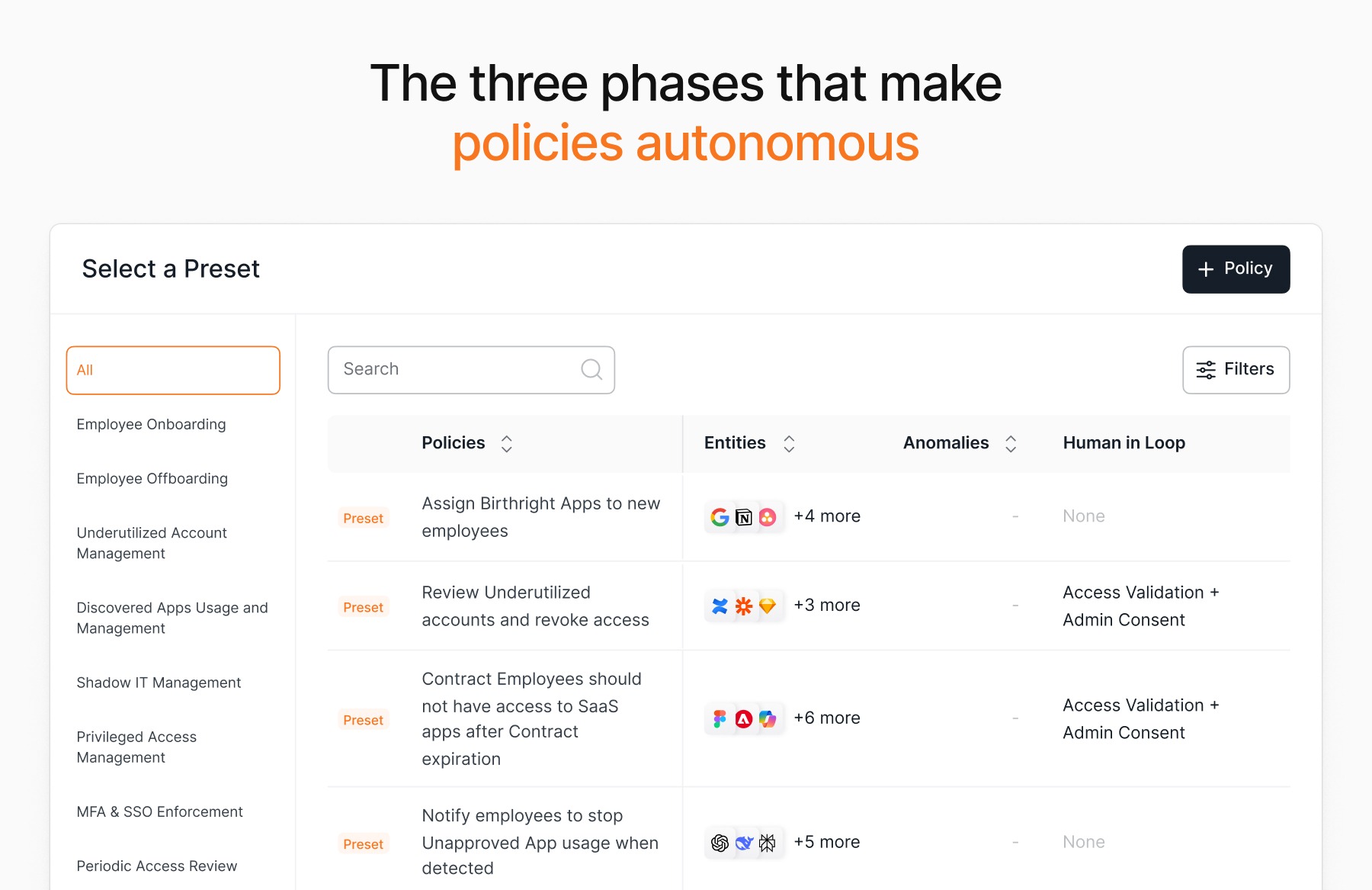
Josys structures policy enforcement as a closed loop across three phases: configure, enforce, and prove. Each phase feeds the next.
Configure: define your ideal access state
Begin by defining what constitutes correct access across your environment. Josys offers 15+ pre-built policy templates for SOC 2, ISO 27001, CIS Controls, and common access hygiene rules, so you do not start from scratch. Templates are customizable by department, identity type, application, risk level, or any relevant attribute.
Beyond template configuration, Josys analyzes usage patterns across connected applications and recommends policies that have not yet been created. Observed behavior in your environment becomes enforceable governance, allowing you to address previously unidentified gaps.
A governance policy in Josys is built from several layered components, using the example of an underutilized accounts policy:
- Trigger: Fired when an account has been inactive for 35 days.
- Identity Selection: Narrows the scope to specific groups, departments, or locations (human or non-human).
- Application Targeting: Focuses enforcement on a particular application, such as Box.
- Access Validation: Automatically asks the user if they still need access or routes the query to a reviewer.
- Admin Consent: Acts as a guardrail by requiring explicit approval before remediation runs.
- Action Branching: Defines a primary action (e.g., revoking access) and a failure action (e.g., opening a Jira ticket).
- Retrospective Application: Applies the policy to existing violations to close gaps from day one.
Enforce: detect violations and remediate automatically
Once baselines are established, Josys provides continuous monitoring. Every identity, application, and entitlement is compared against policy in real time.
When access deviates from the baseline, Josys responds. Stale accounts are flagged and deprovisioned, excess permissions are revoked, and MFA gaps are enforced. Low-risk violations are addressed automatically, while high-risk changes that require judgment are routed to the appropriate administrator with full context, enabling efficient reviews.
Prove: maintain an audit-ready enforcement ledger
Every policy check, remediation action, administrator decision, and exception is recorded in a single audit ledger. You can filter by policy, identity, date range, or application and export to CSV or PDF as needed. When auditors arrive, the evidence is readily available, eliminating the need for last-minute data collection.
The enforcement dashboard gives you continuous visibility into policy drift, anomaly patterns, and enforcement coverage across your entire identity stack.
One loop – not three moving parts
Managing access without a unified system means coordinating across separate stages: a tool for defining policies, a different process for detecting violations, and yet another workflow for remediating them. Each handoff is a delay. Each gap between stages is where risk accumulates.
The problem isn't any single tool. It's the fragmentation. When policy definition, detection, and remediation live in different places, your team has to be the connective tissue – manually tracking what triggered what, who needs to act, and whether it actually happened. That coordination overhead is exactly what slows teams down when speed matters.
Josys closes the loop by unifying all three on a single platform. A policy defined in Josys is the same policy that gets monitored, the same policy that triggers remediation, and the same policy that appears in your audit trail. There's no translation between systems, no lag between detection and action.
Josys connects to 350+ applications natively. For anything not in that catalog, AI Integration Builder extends enforcement to any app that can be integrated – so your policies apply across your entire stack, not just the well-supported parts.
Compliance that's grounded from day one
Most teams treat compliance as a destination: you do the governance work, then you demonstrate compliance at audit time. Josys inverts that.
Every policy in Josys is grounded in recognized global standards from the start:
- NIST 800-53: identity lifecycle management, least privilege enforcement, MFA requirements
- ISO 27001: access control, privileged access rights, periodic access reviews
- CIS Controls: asset inventory, account management, shadow IT detection
- NIS2: EU-mandated access governance for organizations delivering essential services
- DORA: ICT resilience and third-party access controls for financial services
When your policies map to these frameworks, every enforcement action continuously produces audit evidence. You're not preparing for compliance reviews. You're always ready for them.
Governance doesn't stop at policy creation
The gap in most identity governance programs isn't awareness. Most teams know what good governance looks like. The gap is the distance between defining a policy and continuously running it across all identities and apps in your environment.
Policies close that gap – but only when they're enforced autonomously. Define the rulebook once. Let it run.
One area where this becomes even more complex: AI agents. Governing human identities is one problem. Governing machine identities – agents that access apps, make decisions, and operate across your stack without human checkpoints – is a different one. That's the next frontier for autonomous policy enforcement, and it's worth a dedicated look. Interested in learning more? Book a demo to learn how Josys makes governing identities simple.
over your identities, applications, and files?
Sign-up for a 14-day free trial and transform your IT operations.





Questions? Answers.




What is Josys?

End-to-End Identity
Governance made easy for IT


