This site uses third-party website tracking technologies to provide and continually improve our services, and to display advertisements according to users' interests. I agree and may revoke or change my consent at any time with effect for the future.
Every ungoverned application in your environment is an ungoverned identity. The exposure from uncontrolled application growth isn't primarily about licensing waste – it's about the attack surface that expands every time an employee signs up for a new tool, connects a service account, or deploys an AI agent outside any governance workflow.
At its root, SaaS sprawl is an identity governance failure. Unauthorized applications create accounts that bypass MFA enforcement. Shadow IT introduces credentials that never appear in your identity provider. Orphaned accounts from departed employees stay active for months. Machine identities and AI agents accumulate excessive permissions that nobody reviews. This article outlines 10 strategies to contain that attack surface.
What is SaaS sprawl?
SaaS sprawl is the uncontrolled proliferation of SaaS applications across an organization – tools adopted without formal procurement, provisioned without IT oversight, and left running without governance. Three forces drive most of the growth: low-friction onboarding (any employee with a corporate card can deploy a new tool in minutes), decentralized purchasing that sits outside traditional IT procurement cycles, and the rise of non-human identities – service accounts, API integrations, and AI agents – that connect to SaaS platforms without entering any HR-driven identity lifecycle.
The security consequences
Every SaaS application connected to your corporate environment is a potential entry point. Accounts persist after employees leave – sometimes for months – retaining access to sensitive data in applications that never appeared in the offboarding workflow. Applications adopted outside IT create data flows that bypass your DLP controls and compliance requirements. And non-human identities now outnumber human identities in many enterprise environments: most SaaS management tools never discover them, leaving the fastest-growing segment of the identity surface completely ungoverned.
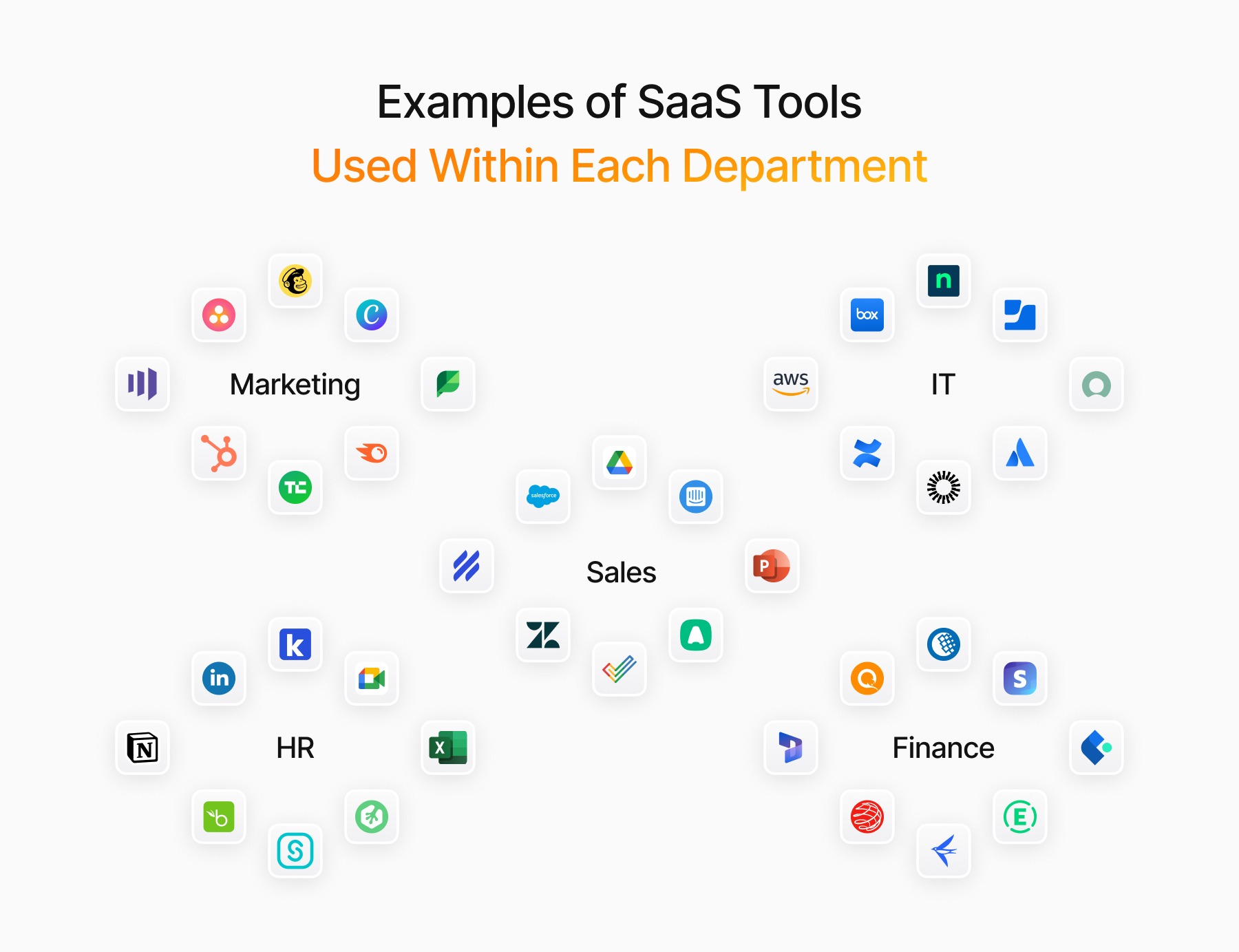
Examples of SaaS Tools Used Within Each Department
Marketing Department: Multiple SaaS apps, such as CRM tools, email marketing platforms, and social media management software, lead to fragmented data and wasted ad spend.
Sales Team: Adoption of various SaaS applications, including CRM systems and sales engagement platforms, can fragment data and disrupt the sales funnel.
Human Resources: Reliance on various SaaS tools, such as applicant tracking systems and payroll software, can create management inefficiencies.
Finance Department: Utilization of SaaS applications for accounting and budgeting may complicate data management and financial compliance.
IT Department: Use of various monitoring tools and network management software can complicate operations if not managed cohesively.
10 strategies to contain SaaS sprawl
1. Gain full visibility – including machine and AI identities
Most discovery tools catalog SaaS apps. Fewer catalog the identities within them. The gap matters enormously. Finding applications is necessary. Finding every identity attached to those applications is what security requires. Conduct full discovery at least quarterly, and cross-reference your SaaS inventory with your identity provider, SSO platform, and financial systems. Applications with active users but no corresponding SSO integration are your highest-priority remediation targets.
2. Establish a formal procurement and security review process
A formal process routes every new SaaS request through a security questionnaire, a vendor risk assessment, and a license approval workflow before any corporate data touches the application. Non-SSO-capable applications require a higher bar for justification – or a firm denial. This process disciplines future growth; it does nothing for applications already running, which is why discovery must come first.
3. Implement SSO across every authorized application
Single sign-on is the most effective single control for reducing identity risk. When every application authenticates through your identity provider, you get centralized session control, MFA enforcement across the full portfolio, and a single deprovisioning point for every employee exit. Build the policy explicitly: SSO-capable or not approved.
4. Enforce least-privilege access from day one
Every account provisioned with more access than its function requires is a potential lateral movement path. In SaaS environments, least privilege erodes quickly – applications default to permissive roles, administrators grant elevated access to resolve an incident, and never revoke it. Machine identities and AI agents require the same scrutiny as human users, in many cases more, because their credentials are longer-lived.
5. Automate provisioning and deprovisioning tied to HR events
Automate both workflows by connecting your HRIS to your identity provider, and from your identity provider downstream to every authorized SaaS application. When an employee is terminated in Workday, their accounts across all active SaaS applications should be suspended within minutes – not weeks. Role changes deserve the same treatment: a promotion or transfer should trigger an access review, not the accumulation of indefinite permissions.
6. Conduct regular access reviews and certification campaigns
Run formal access certification campaigns at least twice per year for standard user accounts, and quarterly for privileged and machine accounts. Automated review workflows that surface anomalous access – accounts with permissions no peer holds, accounts inactive for 60 or more days – focus attention where the risk is greatest. Manual spreadsheets generate high-volume, low-quality certifications. They don't scale.
7. Detect and remediate shadow IT
Shadow IT is the most direct manifestation of SaaS sprawl as a security problem. Effective detection combines network traffic analysis, browser extension telemetry, and identity provider log correlation. Applications receiving OAuth grants from corporate accounts appear in the identity provider's app consent logs – a frequently overlooked source of shadow SaaS inventory. A shadow IT list that accumulates without action isn't a control. It's a deferred risk register.
8. Rationalize and consolidate redundant applications
Most organizations carry multiple tools serving the same function. Rationalization audits compare applications against each other and against the core stack to identify functional overlap. Fewer applications mean fewer identity surfaces to monitor, fewer vendor relationships to track for breach disclosures, and simpler SSO and MFA enforcement coverage.
9. Build a cross-functional identity governance framework
An identity governance framework assigns accountability for application security to identifiable teams and individuals. It also defines escalation paths: who approves exceptions to the SSO requirement, who authorizes an AI agent to access production data. Without clear escalation paths, security policies accumulate exceptions with no audit trail. Monthly or quarterly governance reviews surface applications that have grown beyond their original scope, and AI agents across the full SaaS lifecycle that have accumulated permissions through incremental scope creep. Access reviews are most effective when the governance structure gives them real authority to act on findings.
10. Monitor for anomalous access and identity threats in real time
Governance controls reduce risk. Real-time monitoring catches what governance misses: compromised credentials, insider threat behavior, and AI agent activity outside established parameters. Effective monitoring correlates signals across your identity provider, SaaS application logs, and endpoint telemetry. Establish behavioral baselines for every identity in your environment. Deviations should trigger automated investigation workflows – not a weekly report reviewed after the fact.
How does Josys mitigate SaaS sprawl?
Most security teams understand least privilege, access reviews, and deprovisioning. The gap is execution at scale – across hundreds of applications, thousands of human identities, and a rapidly growing population of machine identities and AI agents that no traditional SaaS management tool was built to govern.
Josys is a modern, AI-native identity security and governance platform built for this environment. The platform discovers, governs, and secures every identity – human, machine, and AI agent – across every application in the enterprise. Where legacy tools catalog applications, Josys maps the full identity graph: who has access to what, under what conditions, with what level of privilege, and whether that access is currently active or dormant. Autonomously governed access review workflows replace manual certification spreadsheets. Deprovisioning tied to HR system events runs across all connected applications. AI-native detection identifies access anomalies and initiates remediation before a human analyst opens a ticket.
Book a demo and learn how more than 1,000 organizations and MSPs worldwide use Josys to turns identity from the fastest-growing attack surface into an autonomously governed advantage.
Frequently asked questions
What is SaaS sprawl?
SaaS sprawl is the uncontrolled proliferation of SaaS applications across an organization – tools adopted without IT oversight, provisioned without governance, and left running without regular review. The consequence extends well beyond licensing waste: ungoverned applications create ungoverned identities, producing a distributed attack surface that most security teams cannot fully see or control.
How does SaaS sprawl create security risk?
Ungoverned applications carry ungoverned identities. Employees create accounts that bypass MFA enforcement. Service accounts accumulate standing access that nobody reviews. AI agents receive permissions broader than their documented function. When employees leave, accounts persist across tools that were never part of the offboarding workflow. Each condition is an exploitable gap.
How can organizations prevent future SaaS sprawl?
Prevention requires governance at the procurement stage: every new SaaS application is reviewed against a security questionnaire, SSO is enforced as a procurement condition, and data classification requirements are validated before approval. Prevention also requires continuous monitoring – detecting new OAuth grants, new shadow applications, and new machine identities before they proliferate. SaaS discovery tools are the foundation of that monitoring posture. Reactive discovery conducted annually is always chasing a moving target.