This site uses third-party website tracking technologies to provide and continually improve our services, and to display advertisements according to users' interests. I agree and may revoke or change my consent at any time with effect for the future.
Software-as-a-Service (SaaS) cybersecurity faces unprecedented challenges as organizations increasingly migrate critical functions to cloud platforms. The threat landscape has evolved dramatically, with attackers developing sophisticated techniques specifically targeting SaaS vulnerabilities.
The integration of generative AI across SaaS ecosystems has created new security blind spots that many organizations remain unprepared to address. These attacks frequently bypass traditional security measures by exploiting the unique characteristics of cloud-based software delivery.
As SaaS adoption continues to accelerate, security teams must contend not only with conventional threats but also with emerging risks specific to the SaaS model. The proliferation of AI tools within these platforms has created additional attack vectors that require specialized security approaches beyond legacy protections.
Key Takeaways
SaaS security vulnerabilities have grown significantly, primarily due to rapid AI adoption and integration.
Organizations using generative AI tools without proper security controls face a substantially higher risk of data breaches.
Implementing dedicated SaaS security protocols reduces security incidents significantly compared to traditional cybersecurity measures alone.
The Evolving SaaS Cybersecurity Threat Landscape and SaaS Sprawl
As SaaS adoption surges across departments, many organizations are grappling with the rise of shadow IT, unauthorized tools and platforms used without IT oversight. While these apps often boost productivity, they also introduce serious security risks, as they operate outside official monitoring and control frameworks.
With more integrations and data flowing between SaaS platforms, the attack surface has expanded dramatically. Each connected app, API, or third-party service introduces new vulnerabilities, making it harder to track and secure sensitive information. Cybercriminals are exploiting these complex ecosystems, targeting weak links to gain unauthorized access.
A rapidly growing dimension of this challenge is Shadow AI, the use of unsanctioned generative AI tools by employees without IT approval or oversight. When staff connect AI tools like personal ChatGPT accounts, code assistants, or AI-powered browser extensions to enterprise SaaS data, they create unmonitored data pathways. These pathways bypass security controls entirely.
The human factor further amplifies the threat. More users mean more devices and entry points, each a potential vector for phishing, credential theft, or accidental data leaks. As businesses scale their SaaS usage, centralized visibility, access controls, and user training become critical to maintaining a secure environment.
Top SaaS Cybersecurity Risks In 2026
1. Shadow IT And Unmonitored SaaS Usage
Shadow IT continues to present significant risks as employees adopt unauthorized SaaS applications without IT approval. According to CSO Online research, Gartner found that 41% of employees acquired or created technology outside IT's visibility in 2022. That figure is expected to climb to 75% by 2027.
SaaS sprawl means enterprises use many cloud services. Yet security teams are aware of only a fraction.
This visibility gap creates dangerous blind spots where sensitive data flows through unvetted channels. Organizations face increased risks of data leakage, compliance violations, and potential entry points for attackers.
Modern shadow IT often appears in the form of departmental SaaS purchases, freemium applications, and browser extensions that integrate with approved applications. These connections create unmonitored data pathways that bypass security controls.
Employee education on approved application processes
Zero-trust frameworks that control application access regardless of source
2. Overprivileged Accounts & Misconfigured Access
Excessive permissions remain a leading cause of SaaS security incidents. The majority of SaaS users have more privileges than their roles require, creating unnecessary attack surfaces.
Default configurations often grant broad access rights that violate least-privilege principles. When these settings remain unchanged, they create pathways for lateral movement during breaches.
Critical misconfigurations include:
Unrestricted sharing settings allowing external access to sensitive documents
Inactive but enabled accounts from former employees or contractors
Global admin proliferation instead of role-based permissions
Unenforced MFA for privileged accounts
Organizations now implement continuous permission right-sizing through regular user access reviews and automated tooling that identifies excessive privileges and dormant accounts. Adaptive access policies that adjust permissions based on behavioral patterns and risk scores have become essential for modern SaaS security.
3. Third-Party App Integrations & OAuth Exploits
Enterprise SaaS environments integrate with many third-party applications via OAuth and APIs. These connections, while necessary for productivity, create significant security vulnerabilities.
OAuth token exploitation has emerged as a primary attack vector. Malicious applications request excessive permissions that users casually approve, granting attackers persistent access to critical systems without triggering security alerts. The 2025 Salesloft Drift OAuth supply-chain attack exposed more than 700 organizations by leveraging stolen tokens from a single trusted third-party integration.
Recent incidents demonstrate how compromised third-party applications can lead to enterprise-wide breaches. When a single integration is compromised, attackers gain access to multiple connected services through trusted relationship chains.
Security teams now implement:
Centralized OAuth governance systems
Integration approval workflows
Regular token auditing and rotation policies
Automatic detection of suspicious permission requests
The most advanced organizations maintain comprehensive integration inventories that document data flows between applications and enforce granular API permissions.
4. Lack Of Visibility Across SaaS Stack
As SaaS sprawl makes portfolios increasingly complex, security teams struggle to maintain comprehensive visibility. Most organizations now use numerous SaaS applications across departments, creating security blind spots between platforms.
This fragmented environment complicates security monitoring, as traditional perimeter-based tools fail to capture cross-application activities and data movements. Security teams cannot protect what they cannot see.
Visibility challenges extend to user behavior within applications. Without proper monitoring, suspicious activities like mass downloads, unusual access patterns, or configuration changes often go undetected until breaches occur.
New approaches focus on:
Cross-application activity monitoring
Unified SaaS security dashboards
User behavior analytics specific to SaaS environments
Automated configuration assessments
Organizations implement dedicated SaaS Security Posture Management (SSPM) solutions that continuously monitor settings, permissions, and activities across the entire SaaS ecosystem. These tools provide security teams with comprehensive visibility previously impossible with fragmented monitoring approaches.
5. Insufficient Offboarding Processes
Incomplete offboarding creates persistent security risks as organizations fail to remove access when employees depart fully. A significant portion of companies have discovered that former employees still access SaaS applications long after departure.
The problem extends beyond primary corporate accounts to include:
Personal accounts with corporate data access
Shared logins and password managers
OAuth connections to personal applications
Downloaded data on personal devices
Traditional identity management systems often miss these secondary access points, creating long-term vulnerability. Even when primary accounts are deactivated, residual access remains through various channels.
Effective offboarding now requires automated discovery and revocation processes that extend beyond corporate identity systems. Organizations implement specialized tools that track all possible access pathways and ensure complete removal when employment ends.
6. Data Residency & Compliance Gaps
Evolving data protection regulations have created complex compliance challenges for SaaS users. With data sovereignty requirements now enforced across a growing number of countries, organizations struggle to maintain compliance across their SaaS portfolio.
SaaS applications often store and process data across multiple geographic regions, creating unintentional compliance violations. Many organizations lack visibility into where their data actually resides within SaaS environments.
Critical compliance gaps include:
Uncertain data storage locations
Inadequate data transfer controls
Missing documentation for regulatory audits
Incomplete Data Processing Agreements
Organizations implement data residency controls through specialized tools that map information flows across SaaS applications. These solutions enforce policies that restrict where sensitive data can be stored and processed, ensuring compliance with regional regulations like GDPR, CCPA, and emerging frameworks. Data residency requirements vary widely by region, with GDPR violations alone potentially ramounting to4% of global revenue or €20 million per infraction.
Leading SaaS Security Solution Categories for 2026
While understanding the risks is crucial, organizations need purpose-built tools to address these challenges. The SaaS security market has evolved into several key categories:
SaaS Security Posture Management (SSPM): Continuously scans your SaaS environment for misconfigurations, risky permissions, and policy violations. This helps prevent exploitable gaps before they lead to breaches. Platforms like Obsidian Security and AppOmni provide ongoing configuration assessments benchmarked against CIS and NIST.
Data Loss Prevention (DLP): Monitors and stops sensitive data exfiltration from SaaS platforms through behavioral analytics and content inspection. Solutions, including Forcepoint and Microsoft Purview, are essential for preventing breaches and ensuring regulatory compliance across cloud environments.
Cloud Access Security Brokers (CASBs): Sit between users and SaaS applications to enforce security policies, detect anomalous access, block shadow IT, and apply DLP inline. Tools such as Netskope and Zscaler are critical because every employee using a SaaS app is a potential entry point for a breach.
Identity & Access Management (IAM): Centralizes user permissions, enforces MFA and least-privilege access, and applies zero-trust verification across all SaaS environments. Platforms such as Okta and Josys address credential compromise, one of the most common SaaS breach vectors.
Threat Detection & Response (SIEM/XDR): Aggregates and correlates logs from across your SaaS ecosystem to detect suspicious behavior and accelerate incident response. Solutions like Microsoft Sentinel and Splunk enable security teams to move from reactive to proactive breach detection.
Backup & Recovery: Often overlooked, SaaS providers do not guarantee full data recovery after a breach or ransomware attack; that responsibility falls on your organization. Dedicated backup tools ensure rapid restore capability and business continuity when incidents occur.
Why Traditional Security Tools Fall Short
Traditional security tools are struggling to keep pace with the evolving SaaS landscape. Designed for on-premises environments, these solutions often lack the specialized capabilities needed to address cloud-specific vulnerabilities and attack vectors.
The Cloud Security Alliance's 2025 report found that many organizations rely on fragmented tools and manual audits. These leave critical gaps across SaaS environments.
Many legacy security solutions fail to provide adequate visibility into SaaS applications, creating significant blind spots in an organization's security posture. Without comprehensive visibility, threat detection becomes reactive rather than proactive. security posture. Without comprehensive visibility, threat detection becomes reactive rather than proactive.
Key limitations of traditional security tools:
Limited API integration with modern SaaS platforms
Inability to monitor cross-cloud data movements
Inadequate identity and access management capabilities
Poor detection of cloud-specific attack patterns
Insufficient automation for incident response
Compliance frameworks like GDPR, HIPAA, and PCI DSS require specialized monitoring and reporting that traditional tools weren't designed to provide. This creates significant challenges during security audits and regulatory compliance audits.
Data protection in SaaS environments demands continuous monitoring of sharing settings, permission changes, and unusual access patterns. Traditional tools typically sample activities rather than providing real-time monitoring.
Vulnerability management becomes particularly challenging because traditional scanning tools can't effectively assess the security posture of SaaS applications. They often miss critical configuration vulnerabilities created by configuration drift within the shared responsibility model.
Modern threats target the integration points between various SaaS applications. Traditional security solutions rarely monitor these connection points, leaving organizations exposed to lateral movement attacks.
Effective data privacy protection requires understanding context around data access and usage, a capability most traditional tools lack. This limitation creates significant risks as data privacy regulations continue to strengthen worldwide.
How Identity Governance Platforms Like Josys Close The Gap
Identity Governance and SaaS Management platforms have emerged as critical tools for organizations seeking to address the growing complexity of cloud security risks. Josys and similar platforms offer comprehensive solutions that address key vulnerability areas through automated discovery, access control, and continuous monitoring.
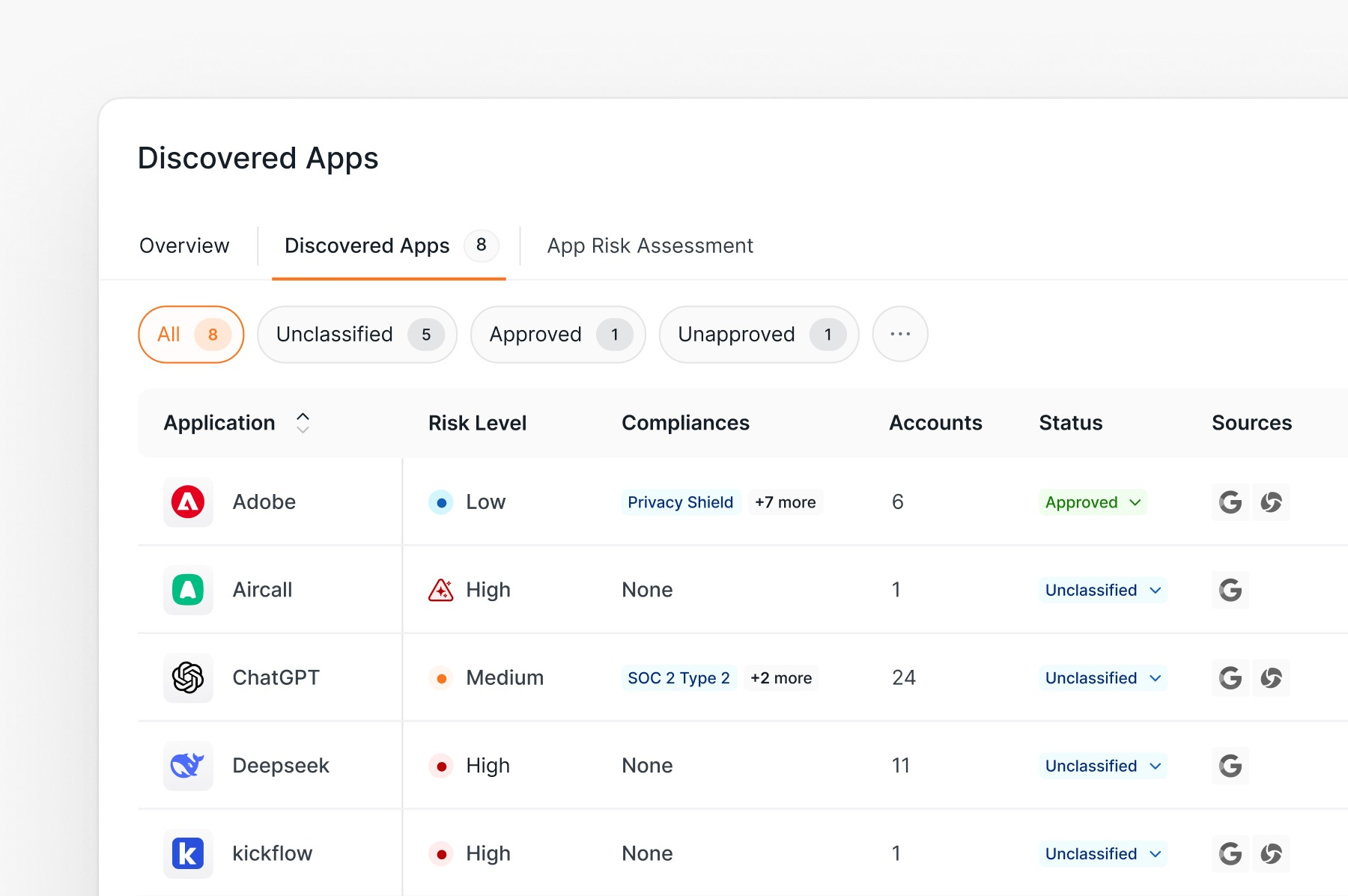
The platform utilizes API connections and network traffic analysis to identify every application accessing company data. This comprehensive visibility extends to user access levels, data-sharing permissions, and integration points across applications.
IT teams can categorize applications by risk level, compliance requirements, and business criticality. With complete visibility, security teams can identify unauthorized applications that may present data leakage risks or compliance violations.
Regular automated scans ensure the SaaS inventory remains up to date as employees adopt new tools. This real-time visibility forms the foundation for effective security posture management across the SaaS ecosystem.
Smart Access Control & Role-Based Permissions
Josys implements sophisticated identity and access management (IAM) capabilities designed specifically for SaaS environments. The platform centralizes user permission management across multiple applications through a single control panel.
Role-based access control templates allow administrators to assign appropriate permissions based on job functions rather than managing individual accounts. This significantly reduces the risk of excessive privileges while streamlining administration.
Multi-factor authentication (MFA) enforcement can be deployed across all managed applications. The platform monitors for permission anomalies, flagging accounts with privilege levels that deviate from established baselines for their roles.
Integration with HR systems ensures access rights automatically adjust when employees change roles. Conditional access policies can restrict application access based on device security posture, location, and other contextual factors.
Automated Onboarding & Offboarding
The employee lifecycle presents significant security risks when not properly managed. Josys streamlines the entire process through access automation, creating standardized workflows for provisioning and deprovisioning user accounts across all SaaS applications.
When new employees join, the platform automatically creates accounts with appropriate permissions based on department and role. Josys eliminates manual configuration errors that could result in excessive privileges.
For departures, Josys executes complete offboarding protocols, revoking access to all applications simultaneously. Josys prevents the common security gap of orphaned accounts with persistent access after employment ends.
License reclamation happens automatically during offboarding, preventing unnecessary costs. The platform can also identify and reassign critical data owned by departing employees to maintain business continuity.
Activity Monitoring & Audit Trails
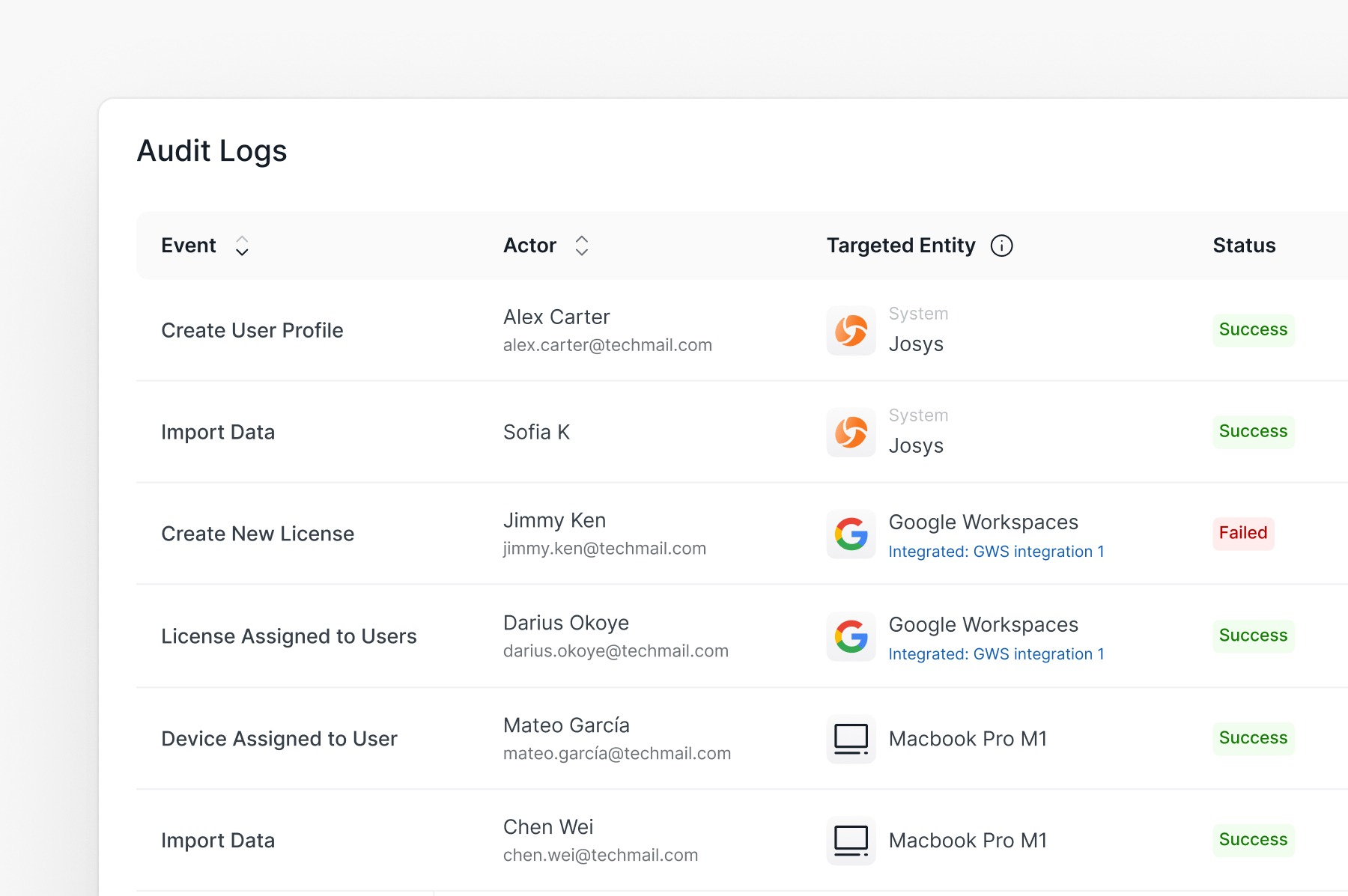
Comprehensive activity monitoring across the SaaS ecosystem allows organizations to detect suspicious behavior before breaches occur. Josys collects and normalizes user activity logs from diverse applications into a unified timeline.
The platform applies behavioral analytics to identify abnormal patterns that may indicate compromised credentials or insider threats. Administrators can view complete audit trails showing who accessed what data, when, and from where.
Real-time alerts notify security teams when high-risk actions occur. These detailed activity records also provide critical forensic evidence when investigating potential incidents.
Compliance Reporting & Data Governance
Meeting regulatory requirements across multiple SaaS platforms has traditionally required manual effort. Josys automates compliance monitoring and reporting for frameworks including GDPR, HIPAA, SOC 2, and ISO 27001.
The platform scans application configurations to detect non-compliant settings and provides guided remediation steps. Data classification tools automatically identify and tag sensitive information across the SaaS ecosystem.
Pre-built compliance dashboards show real-time status across all applications. Josys enables continuous compliance rather than point-in-time assessments.
Data retention policies can be centrally defined and enforced across multiple platforms. The system generates comprehensive evidence packages for auditors, dramatically reducing preparation time.
Geographic data storage restrictions are monitored and enforced to maintain regional compliance requirements. Risk assessments for new applications are automated based on responses to the security questionnaire.
Integration & Risk Scoring
Josys employs sophisticated risk scoring algorithms to evaluate the security posture of each SaaS application. These scores incorporate factors such as security configurations, compliance certifications, and vendor security practices.
Threat intelligence feeds enhance risk scoring by incorporating known vulnerabilities and active threats. Risk remediation workflows guide administrators through the process of addressing identified security gaps. The platform prioritizes issues based on potential impact, allowing security teams to focus efforts where they matter most.
Choosing the Right SaaS Security Approach
When evaluating security solutions for your organization, consider these key factors that distinguish effective platforms from point solutions that leave gaps in your SaaS defense:
✅ Deployment Speed: Solutions should provide immediate visibility without lengthy implementation periods.
✅ Integration Breadth: Ensure the platform connects with SIEM tools, HR systems, and identity providers without complex custom development.
✅ Scalability: Choose solutions that automatically discover new applications, including shadow SaaS and AI tools.
✅ Insider Threat Readiness: Verify the platform includes behavioral analytics to detect anomalies with valid credentials.
✅ Vendor Transparency & Shared Responsibility: Confirm how the vendor defines shared responsibility for SaaS integrations and OAuth connections.
✅ Cost Impact: Evaluate how the platform reduces software waste through license optimization and automated lifecycle management.
✅ Compliance Coverage: Verify the platform supports your regulatory frameworks (GDPR, HIPAA, SOC 2, ISO 27001).
Organizations addressing SaaS sprawl through comprehensive security governance report fewer security incidents. They also achieve substantial cost savings through improved license management and reduced breach risk.
Evolving Cybersecurity Risks
As the SaaS threat landscape continues to evolve, organizations must adapt with security strategies purpose-built for the complexities of modern cloud environments. Traditional tools can't keep pace with SaaS-related risks, from shadow IT and overprivileged access to OAuth exploits and compliance blind spots.
Platforms like Josys close these critical gaps by delivering complete visibility, centralized access control, automated workflows, and continuous risk monitoring. With generative AI and third-party integrations introducing new vulnerabilities daily, the cost of inaction continues to rise.
To stay resilient, organizations must prioritize proactive, purpose-built security solutions that align with today's SaaS-first reality.
Frequently Asked Questions About SaaS Cybersecurity
What is the most common cause of SaaS data breaches?
Most SaaS breaches don't begin with sophisticated external attacks; they start with misconfigurations, overprivileged accounts, or compromised credentials. Shadow IT and unmonitored OAuth integrations are also leading entry points, as they create data pathways that exist entirely outside an organization's security perimeter.
How is SaaS security different from traditional cybersecurity?
Traditional security tools were designed for on-premises environments with a defined perimeter. SaaS security requires continuous monitoring of configurations, user behavior, third-party integrations, and data flows across dozens or hundreds of cloud applications. Legacy tools were not built to handle this at scale.
What is SaaS Security Posture Management (SSPM), and do I need it?
SSPM continuously scans your SaaS applications for misconfigurations, risky permissions, and compliance gaps. It's the proactive layer that prevents exploitable vulnerabilities from accumulating in your stack. Organizations with mature SaaS portfolios typically benefit significantly from SSPM as a foundation for their cloud security strategy.
How do I detect shadow IT in my organization?
Shadow IT detection requires tools that go beyond your approved application list. These tools use API monitoring, network traffic analysis, and identity data to surface unauthorized apps connecting to company data. Platforms like Josys automate this discovery continuously, flagging new applications as they appear rather than relying on periodic manual audits.
What should an effective SaaS offboarding process include?
Effective SaaS offboarding must revoke access across all applications, including OAuth-connected personal tools, shared credentials, and downloaded data, not just primary corporate accounts. Automated offboarding workflows that trigger immediately upon HR system updates are the only reliable way to prevent orphaned accounts from becoming long-term security liabilities.
How does identity governance reduce SaaS breach risk?
Identity governance enforces least-privilege access, automates provisioning and deprovisioning, and provides continuous visibility into who has access to what across your entire SaaS portfolio. By reducing excessive permissions and eliminating dormant accounts, identity governance platforms like Josys dramatically shrink the attack surface. This limits exposure to both external attackers and insider threats.